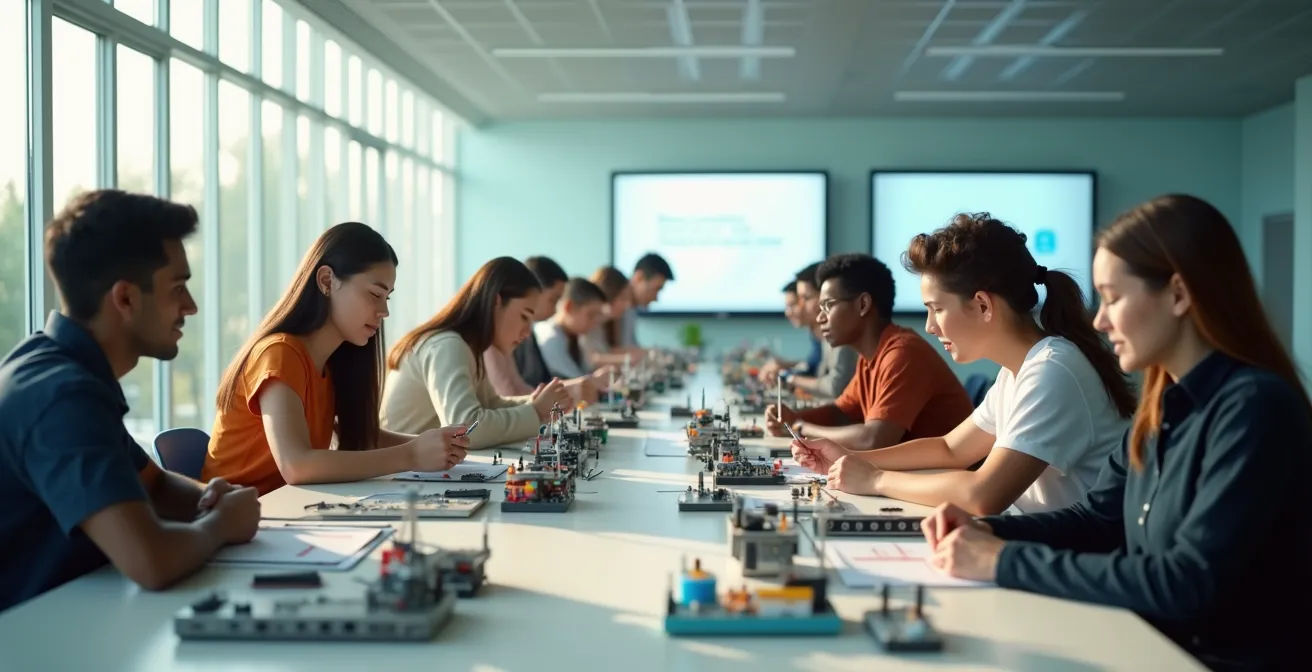
The new STEM standards transform your role from a content deliverer to a learning architect, enabling deeper student engagement and future-readiness.
- The core shift is from memorizing isolated facts to building and defending evidence-based models, mirroring real scientific work.
- Integrating technology and cross-disciplinary projects, like engineering in biology, makes learning authentic and relevant.
Recommendation: Embrace “productive failure” and inquiry-based scaffolding to create a dynamic classroom that truly prepares students for the challenges of tomorrow.
As a science teacher, you’ve likely felt the ground shifting beneath your feet. The introduction of new standards, like the Next Generation Science Standards (NGSS), represents more than just a curriculum update; it’s a fundamental rethinking of what science education should be. The old playbook of lectures, memorization, and cookie-cutter labs is being replaced by a call for inquiry, real-world phenomena, and cross-disciplinary thinking. This transition can feel daunting, leaving many educators wondering how to bridge the gap between traditional methods and these ambitious new goals.
The common advice is to “do more hands-on activities” or “integrate more technology,” but these platitudes often miss the core of the transformation. The real change isn’t just what you teach, but *how* you teach. It’s about moving from being the “sage on the stage” to the “guide on the side.” But what if the key to unlocking this potential isn’t just about adopting new techniques, but about embracing a new identity? What if we reframe the teacher’s role as that of a “learning architect”—a professional who designs, scaffolds, and facilitates authentic investigative experiences for their students?
This article is your blueprint for that transformation. We will explore the economic imperative behind these new standards, provide concrete strategies for classroom implementation, and showcase how technology can become a powerful ally. We will move beyond the theory to give you practical tools and a renewed perspective on your crucial role in shaping the next generation of innovators, problem-solvers, and critical thinkers.
To help you navigate this essential shift, the following video offers a concise overview of the philosophy behind the Next Generation Science Standards.
This guide is structured to walk you through the why, what, and how of this pedagogical evolution. Each section addresses a key question you might be facing, providing data, examples, and actionable advice to empower you in your classroom.
Contents: Your Guide to the New STEM Landscape
- Why Updating STEM Standards is Crucial for National Economy?
- How to Retrain Veteran Teachers on Inquiry-Based Learning?
- NGSS vs Traditional Standards: What Changed in the Classroom?
- The Risk of Raising Standards Without Funding Lab Equipment
- How to Integrate Engineering Projects into Biology Classes?
- How to Integrate Virtual Microscopes into a Biology Syllabus?
- Why Biotech Careers Offer More Direct Patient Impact Than Academia?
- How EdTech Solutions Are Improving Student Engagement in Remote Classrooms?
Why Updating STEM Standards is Crucial for National Economy?
The push to modernize STEM standards is not merely an academic exercise; it is a critical national and economic imperative. The 21st-century economy is driven by innovation, problem-solving, and technological advancement—skills that are at the very heart of the new STEM pedagogy. Traditional education, with its emphasis on rote memorization, fails to produce graduates who can adapt, create, and thrive in this dynamic landscape. The future workforce needs individuals who can analyze complex problems, collaborate on solutions, and think critically, not just recall formulas. Investing in a robust STEM education is a direct investment in a country’s future competitiveness and economic resilience.
The numbers speak for themselves. The demand for skilled STEM professionals is vastly outstripping the supply. For instance, STEM jobs are projected to grow 10.4% between 2023 and 2033, nearly three times the rate for non-STEM jobs. This isn’t just about filling roles in Silicon Valley; it’s about strengthening every sector, from healthcare and manufacturing to finance and logistics. Failing to prepare students for these roles means ceding economic leadership and opportunity. The new standards are designed to build this pipeline of talent from the ground up, ensuring students are not just consumers of technology, but creators and innovators.
Recognizing this, large-scale initiatives are already proving the value of investing in the educator pipeline. The Beyond100K initiative, for example, successfully recruited over 100,000 diverse STEM educators in a decade by creating strong support and retention programs. By focusing on the learning architects themselves, we ensure that the economic benefits of a strong STEM education are realized for generations to come. This is about building human capital, which is the most valuable asset in the global economy.
Ultimately, updated STEM standards are the bedrock of a prosperous future, equipping students with the indispensable skills needed to drive innovation and secure a nation’s economic well-being.
How to Retrain Veteran Teachers on Inquiry-Based Learning?
For veteran teachers who have honed their craft over decades, the shift to inquiry-based learning can feel like learning a new language. The key is to frame this change not as a rejection of their experience, but as an evolution of their role into that of a learning architect. Effective retraining moves beyond one-off workshops and focuses on sustained, collaborative professional development that models the very practices teachers are expected to use in their classrooms. It’s about providing a safe space for them to experience inquiry as learners first, before asking them to facilitate it as teachers.
A successful approach involves breaking down the process into manageable steps. Instead of a complete curriculum overhaul, teachers can start by revising a single unit or lesson. This allows them to practice the cycle of designing, facilitating, and assessing an inquiry-based experience on a smaller, less intimidating scale. The focus should be on questioning techniques, structuring collaborative activities, and guiding students to build arguments from evidence. For example, the ThoughtStretchers Education workshop model provides personalized coaching that helps teachers learn to pull profound thinking from students by contextualizing content with guiding questions, creating a culture of inquiry rather than just a set of activities.
This retraining must also emphasize a crucial mindset shift: embracing productive failure. In an inquiry-based model, a “failed” experiment is a rich learning opportunity, not a mistake to be penalized. Professional development should give teachers the tools and confidence to guide students through the process of analyzing what went wrong and what can be learned from it. It’s about celebrating the iterative nature of science. This gradual, supportive, and practice-based approach empowers veteran teachers to leverage their deep content knowledge and classroom management skills, blending their experience with new pedagogical tools to become masterful guides on the side.
By investing in this kind of thoughtful, teacher-centered professional development, districts can transform apprehension into enthusiasm, turning their most experienced educators into champions of the new standards.
NGSS vs Traditional Standards: What Changed in the Classroom?
The shift from traditional standards to the Next Generation Science Standards (NGSS) represents a seismic change in classroom dynamics. It’s a move away from a two-dimensional model of learning—content and process as separate entities—to a three-dimensional one. This “3D learning” approach masterfully interweaves Science and Engineering Practices (SEPs), Disciplinary Core Ideas (DCIs), and Cross-Cutting Concepts (CCCs). Instead of just learning *about* photosynthesis (a DCI), students now engage in the *practices* of scientists—like developing models (an SEP)—to understand how energy flows through systems (a CCC). The classroom transforms from a lecture hall into a collaborative laboratory where students are active investigators, not passive receivers of information.
This table clearly illustrates the fundamental differences in approach, highlighting the transition from a focus on final answers to valuing the entire investigative process.
| Aspect | Traditional Standards | NGSS Standards |
|---|---|---|
| Focus | Single facts and formulas | Building defensible models with evidence |
| Assessment | Testing final product/answer | Grading process, collaboration, iteration |
| Role of Failure | Mistakes penalized | Productive failure rewarded |
| Student Role | Passive receiver | Active investigator |
| Skills Emphasized | Memorization | Critical thinking, problem-solving |
This new model requires a profound shift in both teaching and assessment. The teacher’s role evolves into that of a facilitator who designs experiences, poses guiding questions, and helps students make connections. As the National Research Council states, this requires teachers with both deep content knowledge and strong pedagogical skills.
The curriculum must be focused, rigorous, and coherent; the instruction must be provided by teachers with deep content knowledge and the pedagogical ability to make that content accessible to students.
– National Research Council, Improving STEM Curriculum and Instruction Report
The visual of a modern NGSS classroom is one of dynamic collaboration. Students are clustered in groups, arguing respectfully over data, sketching models on whiteboards, and revising their ideas based on new evidence. It’s messy, it’s noisy, and it’s where real, lasting learning happens.
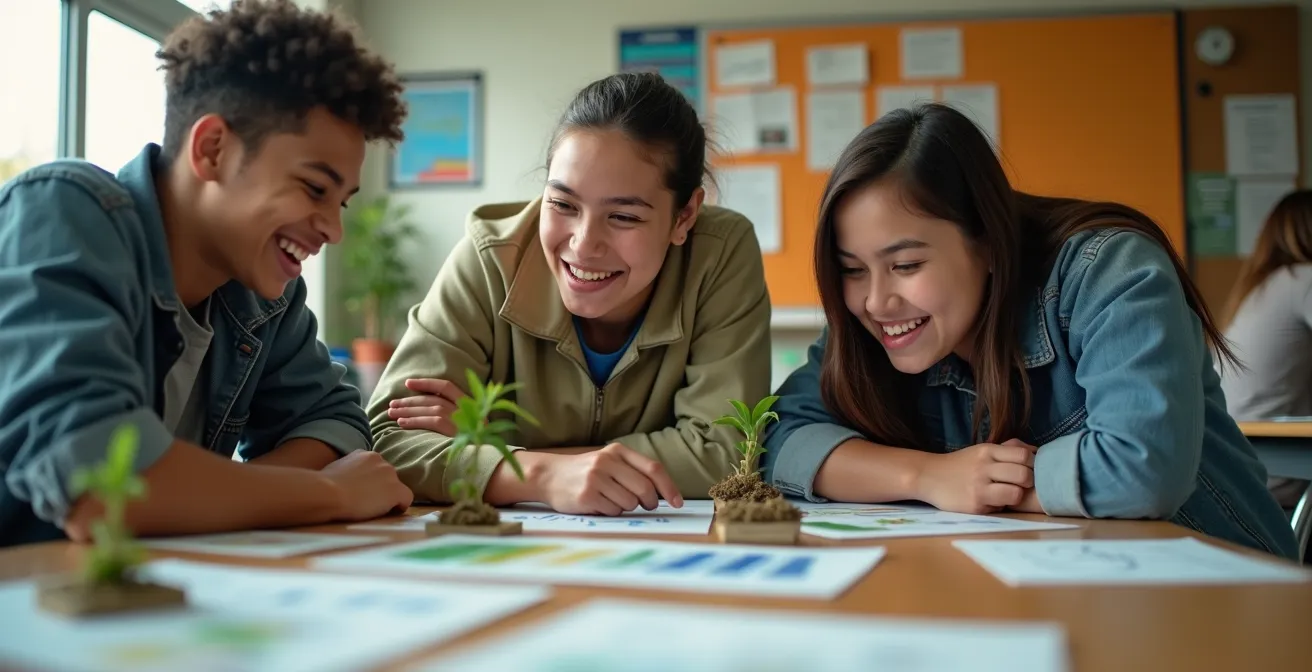
In essence, the change is a move from teaching science as a collection of established facts to guiding students to experience science as a way of knowing and understanding the world.
The Risk of Raising Standards Without Funding Lab Equipment
There is a significant and dangerous disconnect between the ambitious goals of new STEM standards and the financial reality of many school districts. You cannot expect students to act like engineers and scientists without giving them the tools to do so. Raising standards without a parallel commitment to funding creates an equity crisis, where students in well-funded districts have access to cutting-edge labs and technology, while those in underfunded areas are left trying to conduct 21st-century science with 20th-century equipment. This exacerbates existing inequalities and effectively tells a segment of the student population that authentic STEM experiences are not for them.
The funding disparities are stark and deeply entrenched. A 2024 report revealed a staggering $13,000 to $14,000 per pupil funding gap between the highest and lowest funded states, a chasm that directly impacts a school’s ability to purchase lab equipment, subscribe to software, and maintain facilities. When a school struggles to afford basic supplies, the high-level inquiry and engineering design projects envisioned by NGSS become a fantasy. This isn’t just a matter of fairness; it’s a critical flaw in the implementation pipeline that risks undermining the entire reform effort before it can even take root.
However, resourcefulness and innovation are hallmarks of great teachers. While advocating for systemic funding changes is crucial, educators are also finding brilliant ways to bridge the gap. Being a learning architect in a low-resource environment means becoming an expert in creative problem-solving. This includes:
- Using smartphone sensors as powerful data loggers for physics experiments.
- Implementing “kitchen chemistry” to explore reactions with safe, accessible household items.
- Leveraging free citizen science projects to engage with real-world data collection and analysis.
- Creating district-wide equipment sharing libraries to maximize the use of expensive items.
- Aggressively pursuing community-based partnerships and grants specifically aimed at STEM resources.
While these workarounds are not a substitute for equitable funding, they demonstrate the commitment of educators to provide the best possible experience, proving that the spirit of inquiry can flourish even in the face of significant material constraints.
How to Integrate Engineering Projects into Biology Classes?
One of the most powerful and sometimes challenging aspects of the new standards is the emphasis on cross-disciplinary thinking. For biology teachers, the idea of incorporating engineering can seem intimidating. However, the natural world is the ultimate engineering marvel, making the integration of engineering design principles a surprisingly organic fit. The key is to reframe engineering not as building bridges or circuits, but as a process for solving problems under constraints—a process that is mirrored everywhere in biology, from the structure of a cell membrane to the dynamics of an ecosystem.
A highly effective approach is through biomimicry—the practice of learning from and mimicking strategies found in nature to solve human design challenges. This immediately connects core biological concepts to real-world engineering problems. For example, a unit on plant biology and photosynthesis can be extended with an engineering challenge: “Design and build a more efficient solar panel inspired by the structure and arrangement of leaves on a plant.” Suddenly, students aren’t just memorizing the parts of a leaf; they are analyzing it as a masterfully engineered system, applying concepts of surface area, light absorption, and resource transport to their own designs.

This approach hits all the marks of 3D learning. Students engage in Science and Engineering Practices (designing solutions, arguing from evidence), apply Disciplinary Core Ideas (from both biology and engineering), and see Cross-Cutting Concepts (like structure and function) in a new light. Other successful projects include:
- Studying kidney function to design more effective water filtration systems for a local stream.
- Analyzing the structure of beehives or termite mounds to design energy-efficient buildings.
- Investigating pollinator decline and then designing and building “bee hotels” to support local insect populations.
These projects transform the biology classroom into an innovation hub, proving that the lines between scientific disciplines are blurred in the real world.
As learning architects, teachers who embrace this cross-disciplinary approach empower students to see biology not as a static set of facts, but as a dynamic source of inspiration for solving the world’s most pressing problems.
How to Integrate Virtual Microscopes into a Biology Syllabus?
The traditional microscope is an icon of the biology lab, but it comes with significant limitations: high cost, fragility, and the logistical challenge of ensuring every student gets adequate time with a quality specimen. Virtual microscopy shatters these barriers, democratizing access to high-quality imaging and opening up new pedagogical possibilities. This technology allows students to explore vast libraries of perfectly prepared digital slides—including rare disease samples or delicate specimens—from any device with an internet connection. The overwhelming preference for this technology is clear; one study found that 96.6% of first-semester students prefer learning via virtual microscope over traditional ones, citing ease of use and the ability to compare slides side-by-side.
The potential goes far beyond simple slide viewing. The award-winning virtual microscope developed at Oregon State University, now an open educational resource, demonstrates the transformative power of this tool. Their platform allows every student, including distance learners, to have an experience that meets the same learning outcomes as on-campus labs. Students can instantly compare hundreds of slides, use AI-powered tools to help identify cell types, and collaborate on annotations in real time. This isn’t just a replacement for a physical tool; it’s a significant upgrade that enhances the learning experience.
For the classroom teacher, the most effective way to integrate this technology is through a “flipped lab” model. Instead of using precious class time for basic slide exploration, students can conduct this initial investigation at home. This frees up classroom time for what matters most: collaborative analysis, discussion, and deeper inquiry guided by the teacher. As a learning architect, you can design activities where students work in teams to analyze a set of virtual slides, formulate a hypothesis, and present their evidence-based conclusions to the class.
Your Action Plan: Implementing a Flipped Lab with Virtual Microscopes
- Set Up the Digital Library: Create a “Virtual Slide Box” or use an existing platform, curating high-quality digital slides relevant to your curriculum.
- Assign Pre-Lab Exploration: Before class, assign specific slides for students to explore at home, providing guiding questions to focus their observations.
- Leverage Class Time for Collaboration: Use in-class time for higher-order thinking. Have students work in groups to compare slides, discuss discrepancies, and build arguments from visual evidence.
- Utilize Digital Tools: Teach students to use annotation tools to mark key features, measure structures, and share their findings with peers for discussion and critique.
- Build a Shared Database: Use a centralized data storage system to create a class-wide database of annotated images and observations that can be referenced throughout the semester.
By embracing virtual microscopy, you’re not just saving money and time; you’re providing a more equitable, engaging, and pedagogically powerful learning experience for every student.
Why Biotech Careers Offer More Direct Patient Impact Than Academia?
As you guide your students through the rigors of the new STEM standards, it’s essential to connect their hard work to tangible, inspiring future pathways. While a career in academic research is a noble pursuit, it’s crucial to show students that the biotech industry often offers a more direct and accelerated route to impacting patient lives. The timeline from a laboratory discovery to a clinical application can be significantly shorter in the agile, milestone-driven environment of a biotech company compared to the often multi-year grant cycles and publication pressures of academia. In biotech, the daily work is explicitly aimed at developing a therapeutic, a diagnostic, or a medical device that will directly address a patient’s needs.
This direct line to patient impact is a powerful motivator for a new generation of scientists. They can work on teams developing gene therapies for rare genetic disorders, creating new diagnostic tools for early cancer detection, or engineering living medicines. This work is not only intellectually stimulating but also deeply rewarding, providing a clear answer to the question, “How is my work making a difference?” Furthermore, the financial incentives are compelling, which is a significant factor in attracting top talent to solve these critical health challenges. The median annual wage for STEM occupations is $101,650, more than double that of non-STEM jobs, allowing graduates to build a secure future while pursuing passion-driven work.
To create this pipeline of future innovators, however, the work starts in your classroom. As the National Science Board powerfully states, the foundation of this entire ecosystem is the educator. They are the ones who ignite the initial spark of curiosity and provide the rigorous training necessary for students to succeed.
Investment in education at all levels is greatly needed in our country. The nation must rapidly recruit, train, and retain diverse STEM educators, particularly for underserved student populations and school districts.
– National Science Board, Science and Engineering Indicators 2024
By framing their science education as the first step toward a career with direct human impact, you empower students to see their daily lessons not just as schoolwork, but as training for a mission.
Key Takeaways
- The shift to new STEM standards is an economic necessity, designed to build a workforce of innovators and problem-solvers.
- Your role is evolving from an instructor to a “learning architect” who designs inquiry-based experiences and values “productive failure.”
- Integrating engineering (like biomimicry) and technology (like virtual microscopes) makes learning authentic, cross-disciplinary, and more accessible.
How EdTech Solutions Are Improving Student Engagement in Remote Classrooms?
The global shift towards remote and hybrid learning has accelerated the need for EdTech solutions that do more than just digitize a textbook. The challenge is to maintain, and even enhance, student engagement when the physical classroom is no longer the primary learning environment. The most effective EdTech solutions are those that replicate and amplify the collaborative, inquiry-based spirit of the new STEM standards. They are tools for co-creation, not just content consumption. They empower students to participate in authentic scientific practices, regardless of their physical location.
A groundbreaking example comes from UC Santa Cruz, where researchers developed remote-controlled, internet-connected microscopes. This technology enabled high school students, including many from underrepresented communities in the US and Latin America, to conduct complex tissue culture experiments—a practice typically unheard of outside a university lab. Students weren’t just watching a video; they were logging in, controlling sophisticated equipment miles away, collecting data, and collaborating with peers. This is the pinnacle of remote engagement: providing access to authentic experiences that would otherwise be impossible.
The key to success is designing activities that foster active co-creation. This moves beyond the passive model of watching a recorded lecture and into a dynamic space of shared discovery. Effective strategies include:
- Implementing collaborative virtual microscopy sessions where teams of students annotate the same digital slide in real-time.
- Using cloud-based platforms that allow students to work together on data analysis or the design of a virtual experiment.
- Setting up peer-review systems where students can provide feedback on each other’s work and vote on the quality of experimental markers or conclusions.
- Providing 24/7 access to virtual lab resources, allowing for flexible, self-paced learning that accommodates diverse student schedules and needs.
These technologies transform the learning environment, making every student an active participant in the scientific process.
As a learning architect, your role is to select and implement these tools not as simple tech upgrades, but as strategic instruments to build a more engaging, equitable, and authentic science education for every single student, no matter where they are learning.