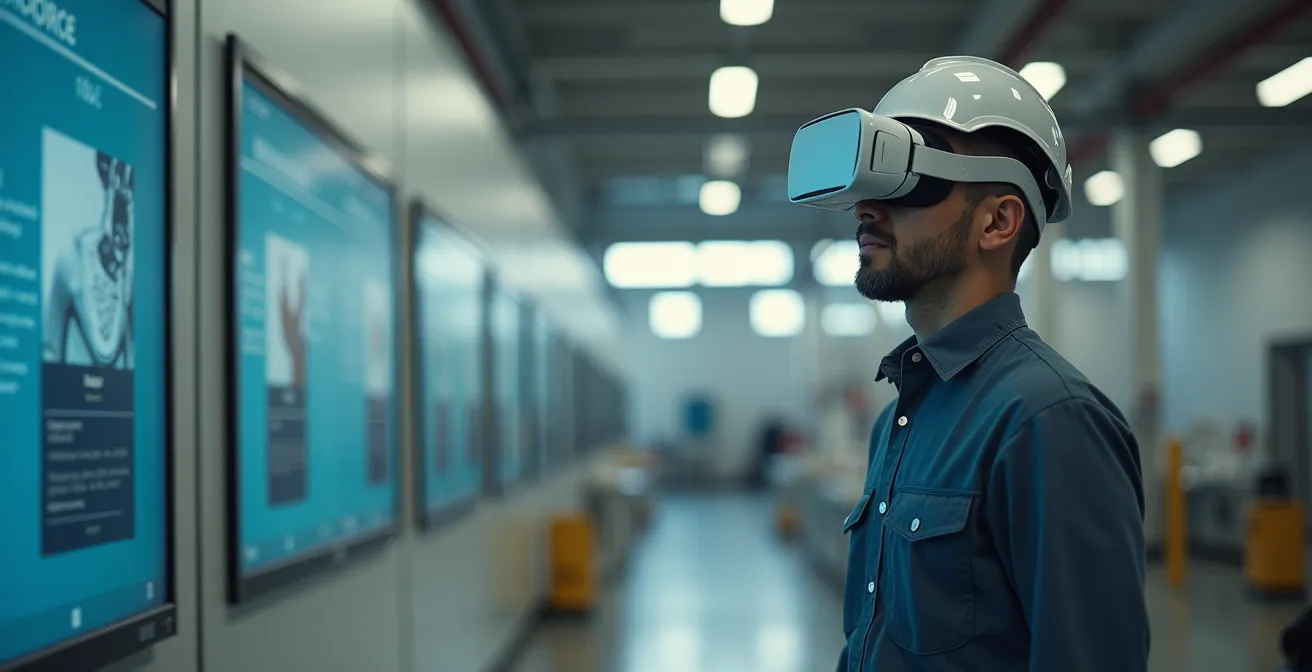
VR training slashes accident rates not by being a better screen, but by fundamentally re-engineering an employee’s cognitive and neurological responses to risk.
- It creates “muscle memory” for safety protocols in a psychologically safe environment, where failure is a learning tool, not a hazard.
- The financial case is clear: VR training delivers up to a 6x better 5-year ROI than physical mockups by drastically cutting costs and training time.
Recommendation: Shift from a compliance-based training mindset to a performance-based one. Start by identifying one high-risk, low-frequency event in your operations and scope a VR pilot program around it.
As a safety manager, you live with a persistent, uncomfortable truth: the gap between what employees learn in a classroom and what they do under pressure in the field. You’ve deployed the standard arsenal—PowerPoint presentations, detailed manuals, and periodic safety drills. Yet, incidents still happen. The “knowing-doing gap” remains the most dangerous place in any high-risk industry, a chasm where protocol awareness fails to translate into instinctive, correct action during a critical moment. This gap is not a failure of teaching, but a limitation of the medium.
Conventional training informs the conscious mind, but it rarely builds the reflexes needed when a situation deteriorates in seconds. But what if the goal wasn’t just to teach safety, but to hardwire it? To forge safety protocols so deeply into an employee’s procedural memory that the correct response becomes as automatic as breathing. This is the paradigm shift offered by immersive virtual reality (VR) training. The widely cited figure of a 40% reduction in workplace incidents isn’t a marketing gimmick; it’s the measurable outcome of applied neuroscience. It’s the result of moving training from passive reception to active, cognitive re-engineering.
This article moves beyond the surface-level discussion of “realism” to dissect the core mechanisms that make VR an unparalleled tool for risk reduction. We will explore the cognitive science behind its superior knowledge retention, the practical roadmap for a glitch-free implementation, and the undeniable long-term financial ROI. We will also confront the human-factor challenges like motion sickness and strategic deployment, providing expert-driven solutions. This is the blueprint for transforming your safety program from a cost center into a strategic operational advantage.
To fully grasp this transformation, this article breaks down the essential pillars of implementing an effective immersive training strategy. The following sections provide a comprehensive guide, from the underlying cognitive science to practical deployment and return on investment.
Summary: The Blueprint for VR-Driven Safety Excellence
- Why Brains Retain Safety Protocols Better in VR Than in Classrooms?
- How to Implement VR Training Without Technical Glitches?
- Virtual Simulation vs Physical Mockups: Which is Cheaper in the Long Run?
- The “Motion Sickness” Barrier: Why Some Employees Reject VR Training
- When to Deploy Immersive Training: Before or During Onboarding?
- Why Infinite Repetition in VR Builds Confidence Faster Than Real Practice?
- Why You Retain 75% More Knowledge Through Hands-On Workshops?
- How VR Simulations Prepare Surgeons for Rare High-Risk Procedures?
Why Brains Retain Safety Protocols Better in VR Than in Classrooms?
The stark difference in knowledge retention between VR and traditional methods isn’t magic; it’s a function of how the brain is designed to learn. Traditional classroom training primarily engages the brain’s semantic memory—the recall of facts and concepts. While useful, this form of memory is notoriously fragile and disconnected from physical action. Immersive training, however, engages procedural memory, the same system that learns to ride a bike or play a musical instrument. By physically performing a task, even in a virtual environment, the brain creates and strengthens neural pathways connecting the knowledge of a protocol to the actual motor skills required to execute it. This is active learning, not passive consumption.
This experiential encoding is significantly more robust. According to extensive research into learning methodologies, this active participation leads to a dramatic increase in long-term recall. In fact, studies show an 80% retention rate one year after VR training, compared to a mere 10% for traditional lecture-based methods. The brain simply doesn’t give the same weight to information it reads on a slide as it does to an experience it has “lived.”
Furthermore, VR triggers a stronger emotional response. Safely navigating a simulated hazardous materials spill or correctly executing a lockout-tagout procedure on a complex piece of machinery generates a sense of accomplishment and mild stress that enhances memory formation. The research on motor learning highlights that this process initiates long-term potentiation in brain synapses, which is the cellular mechanism for skill learning. It’s the difference between reading a map and actually navigating the terrain. One is an abstract exercise; the other forges permanent neurological pathways. This is the core of cognitive re-engineering for safety.
How to Implement VR Training Without Technical Glitches?
The promise of VR training can quickly be derailed by poor execution. For a safety manager, a failed rollout not only wastes budget but also undermines credibility with both leadership and the workforce. A successful, scalable implementation is not about technology for its own sake; it’s about building a robust and reliable operational process. The goal is to make the technology disappear, allowing learners to focus solely on the training content. This requires a strategic approach that anticipates and mitigates common points of failure, from hardware management to network infrastructure.
A phased rollout is critical. Starting with a small, controlled pilot program allows the IT and safety departments to identify and resolve unforeseen issues before a full-scale deployment. Key considerations include device management, content updates, and, crucially, hygiene. In a post-pandemic world, establishing clear protocols for sanitizing shared hardware is non-negotiable for user adoption. Equally important is ensuring your network can handle the data load. A lagging or buffering simulation destroys the sense of immersion and frustrates the user, negating the very benefits you seek to achieve. Strategic planning prevents technical glitches from becoming program-ending disasters, ensuring the focus remains on safety outcomes, not IT troubleshooting.
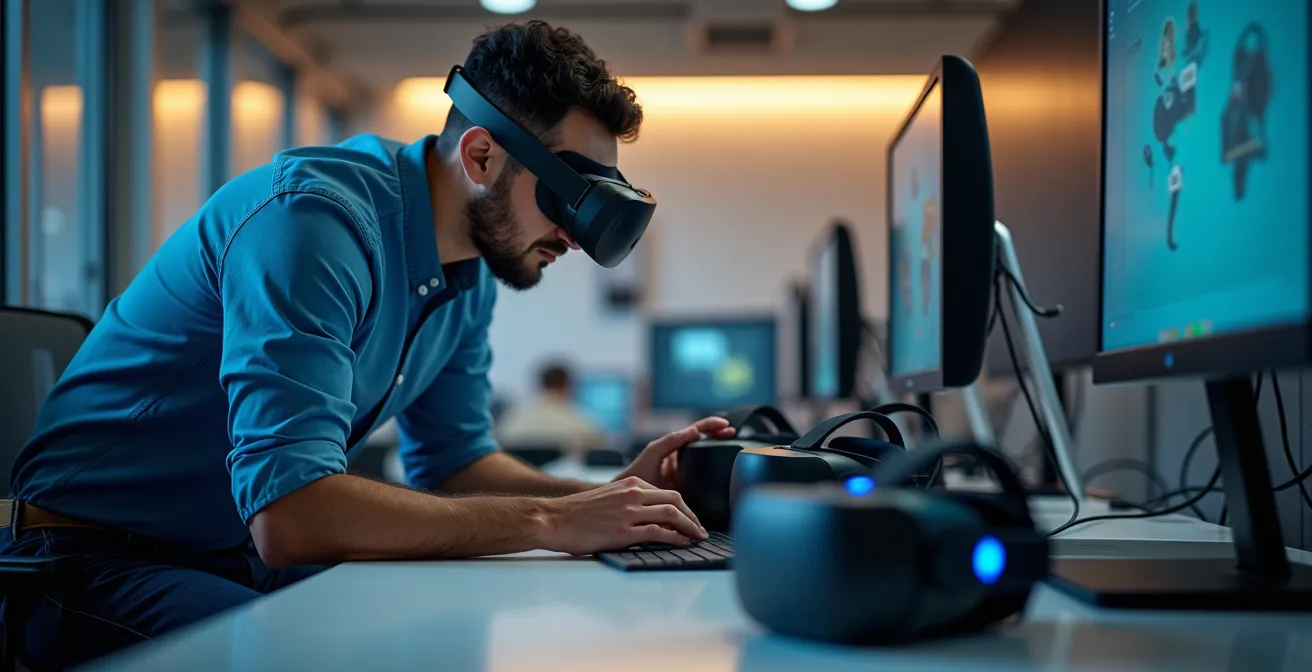
As the image above illustrates, the foundation of a successful program is meticulous preparation. Centralized management systems are the key to scaling efficiently, allowing a small team to manage a large fleet of devices, push content updates remotely, and track usage analytics seamlessly. Integrating these analytics with your existing Learning Management System (LMS) closes the loop, transforming VR training from a standalone novelty into an integrated, measurable component of your corporate safety infrastructure.
Action Plan: 5 Steps to a Scalable VR Training Implementation
- Start with a 10-headset pilot program to test infrastructure requirements and gather initial feedback.
- Implement Mobile Device Management (MDM) systems for remote software updates and content deployment.
- Establish strict hygienic protocols for shared hardware, including UV-C sanitization between user sessions.
- Ensure your network infrastructure supports multiple concurrent VR sessions with a minimum of 50 Mbps per headset.
- Connect VR analytics to your existing Learning Management Systems (LMS) for centralized performance tracking.
Virtual Simulation vs Physical Mockups: Which is Cheaper in the Long Run?
The initial sticker price of VR hardware often gives safety managers pause. It’s easy to compare the cost of a few headsets to the seemingly lower cost of building a physical mockup and conclude that the traditional route is more economical. However, this view is dangerously shortsighted. A true cost-benefit analysis must extend beyond the initial setup fee and consider the total cost of ownership over the entire lifecycle of the training program, factoring in scalability, operational expenses, and training effectiveness.
Physical mockups are inherently static and expensive to modify, replicate, or move. Training 500 employees across three different sites means building three separate mockups and incurring travel and accommodation costs. With VR, the cost to scale is marginal. Once the simulation is built, deploying it to an additional 500 employees costs little more than the price of extra headsets. Furthermore, VR training is demonstrably faster. When employees can complete complex procedural training up to four times faster than in traditional settings, the savings in wages and operational downtime become substantial. These savings, combined with the elimination of travel and facility costs, fundamentally change the ROI equation.
This is before we even consider the largest financial variable: the cost of accidents themselves. As employers currently pay almost $1 billion per week for direct workers’ compensation costs nationwide, any investment that significantly reduces incident rates provides an exponential return. A 40% reduction in incidents translates directly to massive savings in insurance premiums, legal fees, and lost productivity.
The following table provides a clear breakdown of the long-term financial advantages, showing how the higher initial investment in VR is quickly offset by massive operational savings and scalability benefits.
| Cost Factor | VR Training | Physical Mockups | Savings with VR |
|---|---|---|---|
| Initial Setup | Higher upfront investment | Moderate initial cost | -20% initially |
| Scalability (375+ learners) | $50 per additional learner | $200 per additional learner | 52% cost reduction |
| Training Time | 4x faster completion | Standard duration | 75% time savings |
| Travel & Facility Costs | Zero (remote capable) | Significant ongoing | 30-70% reduction |
| 5-Year ROI | 300% projected | 50% projected | 6x better ROI |
The “Motion Sickness” Barrier: Why Some Employees Reject VR Training
One of the most common and legitimate concerns when deploying VR training is the issue of “cybersickness” or motion sickness. When a user’s eyes perceive movement that their inner ear does not, the resulting sensory conflict can cause nausea, headaches, and disorientation. For a safety manager, this isn’t just a comfort issue; it’s an adoption barrier. If a segment of the workforce feels physically ill during training, they will reject the program, and its effectiveness will be compromised. Ignoring this human factor is a recipe for a failed implementation.
However, this challenge is far from insurmountable. Modern VR hardware and software design have made significant strides in mitigating the causes of motion sickness. High-refresh-rate displays and precise one-to-one tracking reduce the latency that often triggers discomfort. More importantly, simulation design itself plays a crucial role. Developers can implement “teleportation” locomotion, where users point and click to move, instead of smooth, joystick-based movement which is a common culprit. The key is to treat cybersickness not as an unavoidable side effect, but as a design problem to be solved through a combination of technology and thoughtful user experience engineering. A proactive approach is essential to ensure inclusivity and build trust in the program.
Case Study: Stanford’s Adaptive VR Acclimatization Program
To address cybersickness systematically, Stanford’s Virtual Human Interaction Lab has developed phased VR acclimatization programs. In these programs, initial sessions are deliberately limited to 20 minutes to prevent sensory overload. Exposure is then gradually increased as participants build tolerance. The lab also strategically implements ‘fixed reference frames’—like a virtual cockpit or control booth—within the simulation. This provides the user’s brain with a stable, stationary object to focus on, dramatically reducing the sense of disorientation and mitigating motion sickness symptoms. This methodical approach has proven highly effective in onboarding even the most sensitive users.
For the small percentage of users who remain unable to use headsets, all is not lost. “Digital Twin” strategies allow the very same simulations to be run in a traditional desktop or “first-person” mode on a standard monitor. This ensures that 100% of the workforce can receive the training content, maintaining consistency and coverage while respecting individual physiological limits. This dual-modality approach is the ultimate solution to the motion sickness barrier.
When to Deploy Immersive Training: Before or During Onboarding?
The question is not whether to use VR, but where in the employee lifecycle it will deliver the maximum impact. Traditionally, safety training is a core component of the onboarding process for new hires. Deploying VR at this stage is a powerful way to move beyond policy lectures and immediately immerse new team members in the practical realities and risks of their roles. It allows them to “experience” the job site and practice critical procedures before ever setting foot on the factory floor, accelerating their time to proficiency and ensuring a baseline of safety competence from day one.
However, a more innovative and strategic approach involves deploying VR even earlier: during the recruitment phase. Using a hyper-realistic job preview as a final-stage screening tool offers profound benefits. It gives candidates an unfiltered, hands-on understanding of the job’s demands—the good and the bad. This “try before you buy” approach works both ways. The candidate can self-select out if the reality of the role doesn’t match their expectations, and the company can assess a candidate’s aptitude and demeanor in a simulated work environment. This dramatically improves hiring accuracy and reduces the significant costs associated with early-stage employee churn.
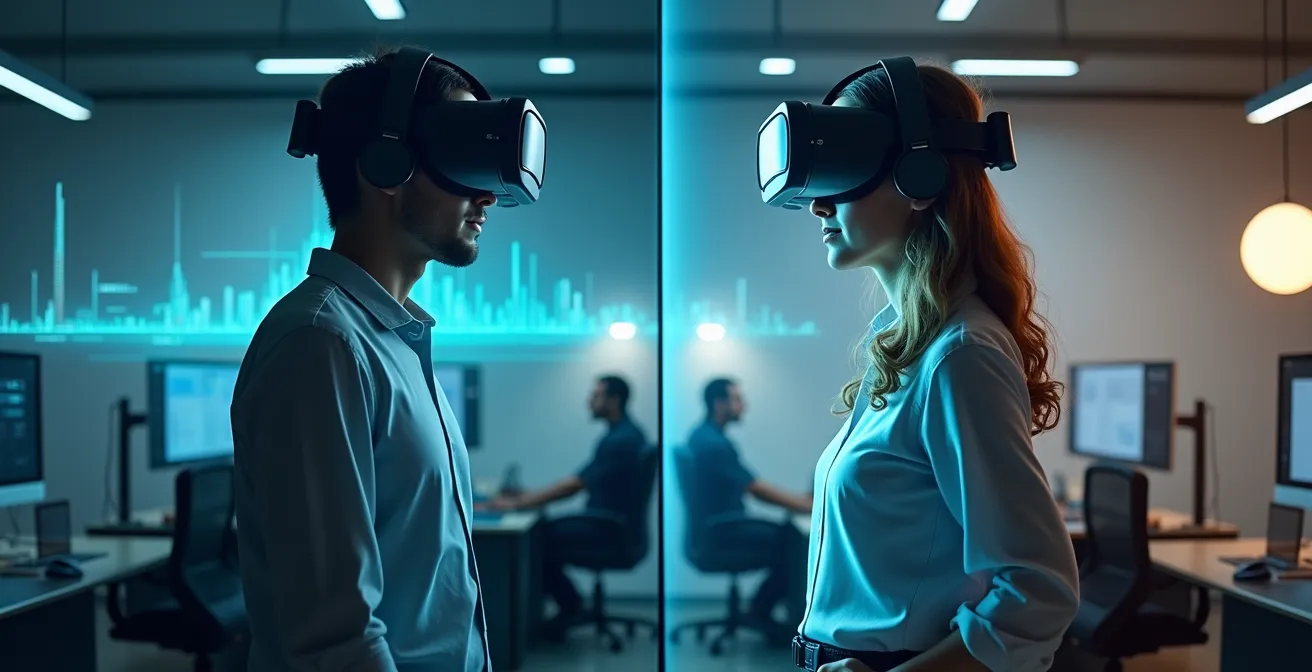
As Dick Hannah, VP of Innovation and Learning at the Houston Area Safety Council, noted in a key report, this pre-hire application is a powerful lever for organizational quality.
VR as a final-stage recruitment tool offers candidates a hyper-realistic job preview to improve hiring accuracy and reduce costly early-stage employee churn.
– Dick Hannah, VP of Innovation and Learning, Houston Area Safety Council Implementation Report
Ultimately, the optimal strategy is not a choice between “before” or “during” but a blended approach. Use VR in recruitment to ensure you’re hiring the right people with the right expectations. Then, use it again during onboarding to equip those people with the critical safety skills and procedural muscle memory they need to thrive safely and productively from their very first day on the job.
Why Infinite Repetition in VR Builds Confidence Faster Than Real Practice?
Confidence is a critical, yet often overlooked, component of workplace safety. A hesitant employee is an unsafe employee. In a real-world emergency, a moment of self-doubt can be the difference between a controlled response and a catastrophic failure. While real-world practice is valuable, it is inherently limited. You cannot repeatedly drill a complex, high-risk procedure on live, multi-million dollar equipment. The cost of materials, the risk of damage, and the required supervisor time make frequent repetition impossible. VR training shatters these constraints.
Within a virtual simulation, an employee can attempt a procedure ten, fifty, or a hundred times in a single afternoon, at zero marginal cost and zero risk. This massive volume of repetition is what forges true mastery and confidence. It allows the learner to move beyond a shaky, step-by-step execution to a fluid, automatic performance. The result is a workforce that doesn’t just *know* the protocol but *owns* it. The data confirms this: studies consistently demonstrate that up to 97% of employees feel more confident and prepared to apply skills they’ve learned in VR to their real-world jobs.
However, the speed of confidence-building in VR isn’t just about repetition; it’s about the environment in which that repetition occurs. This is where the concept of psychological safety becomes paramount. In the real world, practicing a new skill under the watchful eye of a supervisor or peers creates performance anxiety. The fear of making a mistake—of “looking stupid”—inhibits experimentation and slows the learning process. VR removes this social pressure entirely.
Case Study: The Role of Psychological Safety in VR Learning
Neuroscience research on motor learning provides a compelling explanation. The private, non-judgmental nature of a VR environment removes the social fear of failure. This sense of psychological safety encourages learners to experiment, to push boundaries, and even to fail—all of which are essential for rapid skill acquisition. As a study in Frontiers in Human Neuroscience explains, this process removes the fear-based inhibition, which accelerates the learning curve by allowing the brain’s reward and memory circuits to function optimally, solidifying skill retention without the interference of performance anxiety.
Why You Retain 75% More Knowledge Through Hands-On Workshops?
The concept that we learn best by doing is not new. For decades, safety managers have recognized the superiority of hands-on workshops over passive lectures. The “learning pyramid” model has long suggested that active participation—practicing, teaching, or applying a skill—leads to vastly higher retention rates than simply reading or hearing information. Hands-on workshops force the brain to translate abstract knowledge into concrete action, creating a richer, multi-sensory learning experience that is far more memorable. VR training is not a departure from this principle; it is its ultimate, scalable evolution.
Immersive training takes the core benefit of a hands-on workshop—active, experiential learning—and amplifies it, while systematically eliminating its traditional limitations. A physical workshop is constrained by instructor availability, physical space, material costs, and inherent safety risks. VR removes all of these barriers. The “workshop” can be run 24/7, for thousands of employees simultaneously across the globe, without a single dollar spent on materials or travel. It allows employees to practice on a perfect digital twin of a billion-dollar piece of equipment without any risk of damage. The data powerfully supports this, with research demonstrating that VR learners can achieve 75% knowledge retention, a figure comparable to the most effective physical workshops, but with unprecedented scalability.
This is precisely why forward-thinking experts are reframing the conversation around immersive learning.
VR training is the ultimate evolution of the hands-on workshop, delivering the same retention benefit but without the constraints of physical space, instructor availability, or material costs.
– Research Team, Immersive Learning News Analysis 2024
By understanding VR as a “workshop-in-a-headset,” safety managers can make a more compelling case for its adoption. It’s not about embracing a futuristic technology; it’s about taking a proven, common-sense training principle and deploying it with a level of efficiency, consistency, and safety that was previously unimaginable. It is the industrialization of effective learning.
Key Takeaways
- VR’s effectiveness lies in engaging procedural memory, creating “muscle memory” for safety that is far more durable than classroom knowledge.
- A successful VR program is built on operational excellence, requiring a phased rollout, robust IT infrastructure, and strict hygiene protocols.
- While the initial cost is higher, VR offers a vastly superior long-term ROI by eliminating travel, reducing training time, and scaling infinitely at near-zero marginal cost.
How VR Simulations Prepare Workers for Rare High-Risk Procedures?
The ultimate test of any safety program is its performance during a “black swan” event—a rare, high-consequence incident that falls outside the scope of routine operations. These are the scenarios that keep safety managers awake at night: a catastrophic equipment failure, a sudden chemical spill, a complex multi-system shutdown. Traditional training struggles to prepare teams for these events because they are, by definition, impossible to practice safely in the real world. This is where VR simulation transitions from a training tool to a mission-critical strategic capability.
By creating a hyper-realistic digital twin of a facility, companies can drill their teams on the most dangerous and unlikely scenarios until the response becomes second nature. The medical field provides a powerful blueprint; medical studies reveal that surgeons trained using VR make 40% fewer mistakes during high-risk procedures. This same principle applies directly to industrial settings. By allowing teams to experience and manage a simulated crisis, you are inoculating them against the panic and confusion that often accompany real emergencies. You are calibrating their response to failure in a zero-risk environment.
This approach has already yielded dramatic, measurable results in the world’s most dangerous industries. It allows for a level of analysis that is simply impossible in the real world.
Case Study: Preparing for Black Swan Events in the Mining Industry
A major mining corporation implemented VR safety training specifically for rare catastrophic scenarios, including complex machinery shutdowns and chemical spills. The results were staggering: a 43% reduction in lost time from injuries. A key innovation was the use of the simulations for ‘flight recorder’ style debriefs. After a simulated crisis, teams could review a complete record of their decisions and actions without blame, allowing them to identify systemic weaknesses in their emergency response protocols and refine them based on data-driven insights. This is a clear example of how VR transforms training from a compliance activity into a continuous improvement engine.
By embracing VR for high-consequence scenarios, you are not just ticking a training box. You are building organizational resilience. You are giving your team the confidence and competence to manage the unmanageable, ensuring that when the worst-case scenario occurs, their training kicks in and they perform flawlessly.
The evidence is conclusive. Immersive training represents a fundamental shift in how we build a safer, more resilient workforce. The next logical step is to move from understanding to action. Evaluate how a targeted VR pilot program, focused on a specific high-risk task, can be tailored to your organization’s unique operational profile and begin building the business case for a safer future.
Frequently Asked Questions about How Immersive Job Training Reduces Workplace Accidents
What percentage of users experience VR motion sickness?
Studies show approximately 15-25% of first-time users experience some discomfort, but this drops to under 5% after proper acclimatization protocols are implemented, such as shorter initial sessions and gradual exposure.
Can employees who can’t use VR still receive equivalent training?
Yes. Leading strategies use a “Digital Twin” approach, where the same simulation content can be run in a non-immersive “desktop mode” on a standard computer monitor. This ensures 100% workforce coverage and provides a consistent training experience for all employees, regardless of their ability to use a headset.
How long should initial VR training sessions last?
Experts in human factors and VR implementation recommend starting with shorter sessions of 15-20 minutes. This allows new users to acclimate to the virtual environment without sensory overload. The duration can then be gradually increased in subsequent sessions as users become more comfortable and build their “VR legs.”