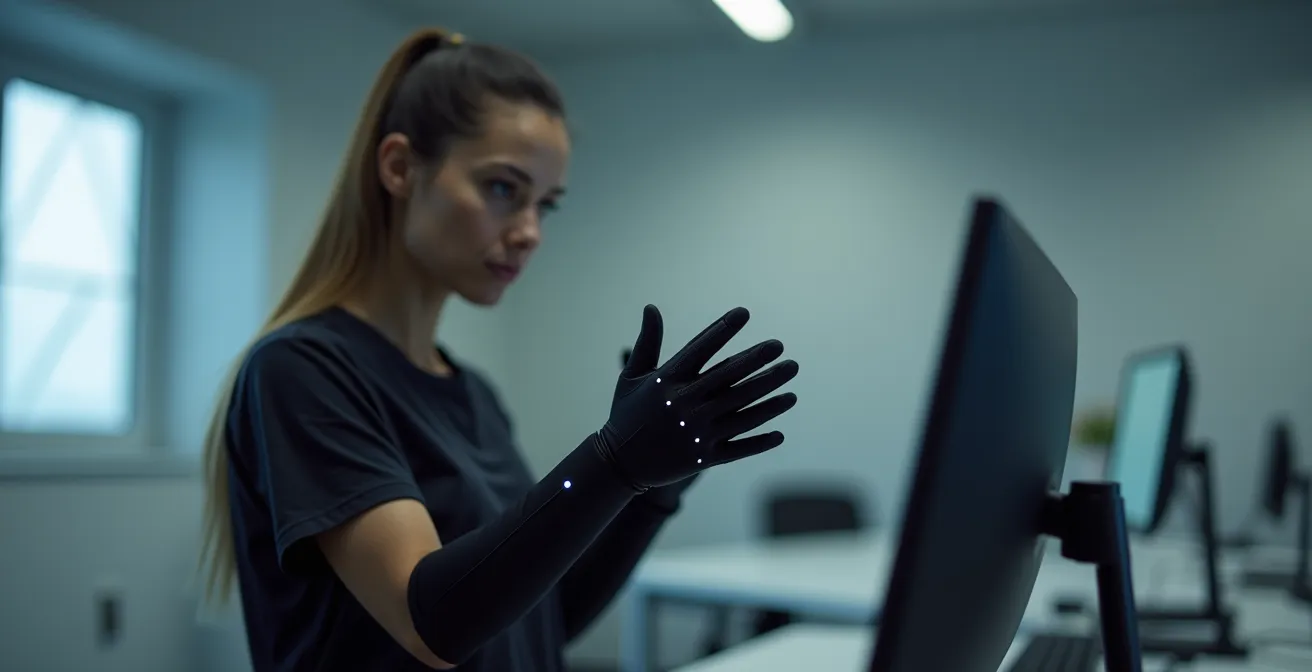
Haptic feedback accelerates virtual training not by simply adding ‘realism,’ but by providing direct proprioceptive data that allows the brain to encode physical movements more efficiently than through visual cues alone.
- Visual-only VR training forces the brain to translate abstract images into motor commands, increasing cognitive load and slowing learning.
- Haptic feedback (force, texture, resistance) provides an immediate, non-visual error correction signal, enabling faster refinement of motor skills.
Recommendation: To maximize skill acquisition, training programs should prioritize haptic systems that offer high-fidelity force feedback calibrated to real-world physics, rather than just general vibrotactile immersion.
The promise of virtual reality (VR) in professional training is vast, offering a safe and repeatable environment to master complex physical tasks. From welding to surgery, simulators allow trainees to practice without risk to themselves or expensive equipment. However, a fundamental limitation persists: the gap between seeing and doing. Traditional VR training relies almost exclusively on visual and auditory cues, forcing the user’s brain to perform a complex translation of abstract 3D information into precise physical action. This process is cognitively demanding and often fails to build the deep, intuitive “feel” that defines true mastery—what we call muscle memory.
The common assumption is that making VR more “immersive” is the solution. But what if the key isn’t just about creating a more believable world, but about feeding the brain the right kind of information? This is where haptic technology enters the equation. It moves beyond simple vibration to simulate nuanced forces, textures, and resistance. This article posits that the true power of haptics lies not in its ability to mimic reality, but in its capacity to create a direct neural pathway for proprioceptive encoding. By providing the brain with the missing sensory data stream of touch and force, haptics reduce cognitive load and allow for the direct, efficient formation of motor skills, accelerating the learning process in a way visuals alone never could.
This analysis will dissect the mechanisms behind this accelerated learning. We will explore why visual feedback is insufficient, how haptic devices are calibrated for realism, compare the available hardware, and address the potential risks. Ultimately, we will demonstrate how this technology is fundamentally changing the landscape of skill acquisition and workplace safety.
Summary: How Haptic Feedback Forges Faster, Deeper Muscle Memory in VR
- Why Visuals Alone Are Not Enough for Learning Manual Trades?
- How to Calibrate Haptic Devices for Realistic Force Feedback?
- Gloves vs Vests: Which Haptic Gear Provides Better Immersion?
- The Risk of Relying on Haptics and Losing Real-World Sensitivity
- How to Reduce Input Lag to Prevent Simulation Sickness?
- Why Brains Retain Safety Protocols Better in VR Than in Classrooms?
- Virtual vs Tactile Skills: What Do Students Lose by Not Touching Equipment?
- How Immersive Job Training Reduces Workplace Accidents by 40%?
Why Visuals Alone Are Not Enough for Learning Manual Trades?
In manual trades, expertise is defined by a refined sense of touch. A surgeon feels the tension in a suture; a technician feels a bolt seating correctly. Visual-only VR simulation cannot replicate this critical feedback loop. When a trainee interacts with a virtual object using a standard controller, their brain receives conflicting information: the eyes see contact, but the hands feel nothing but air and plastic. This sensory dissonance forces the brain to rely solely on visual interpretation to guess the appropriate force, angle, and grip. This is not learning a physical skill; it is learning to play a video game that approximates the skill.
This limitation leads to a high cognitive load, as the user must constantly and consciously translate visual cues into motor actions. Instead of internalizing the physical “feel” of the task, they are focused on manipulating the controller to match a visual target. The result is superficial learning that does not easily transfer to the real world. Without the consequences of touch—the resistance of a material, the subtle vibration of a running motor, the “click” of a locking mechanism—the brain cannot build the robust neural pathways that constitute true muscle memory. Haptics bridge this gap by providing the sensory data that allows the brain to stop guessing and start feeling.
Case Study: Y-12 National Security Complex Virtual Glovebox Training
To train workers handling hazardous materials, the Y-12 National Security Complex’s ORETTC developed a virtual glovebox simulator. By integrating HaptX gloves, the system provides realistic tactile and force feedback. This allows users to “build muscle memory, both mentally and physically,” in a completely safe virtual environment, a feat impossible with visual-only training where the critical feel of handling materials would be entirely absent.
This ability to physically internalize a process is what separates novice performance from expert execution. By re-introducing the sense of touch, we shift the learning process from a purely cognitive exercise to a holistic, neuro-motor one.
How to Calibrate Haptic Devices for Realistic Force Feedback?
Creating believable force feedback is not about brute strength; it is about precision, speed, and nuance. The goal of calibration is to achieve sensory congruence, where the force felt by the user’s hand perfectly matches the visual information on screen. This process involves a meticulous alignment of software physics engines with the hardware capabilities of the haptic device, such as servo motors, magnetic brakes, or microfluidic actuators. Calibration begins by defining the physical properties of virtual objects: their weight, density, stiffness, and surface friction.
Engineers then map these properties to the device’s feedback mechanisms. For example, when a user grasps a virtual metal pipe, the software calculates the expected resistance based on its defined stiffness. This command is sent to the haptic glove, which might use actuators to apply counter-pressure to the user’s fingers, simulating the pipe’s unyielding surface. The key is latency. As noted by the Strivr Research Team, “Force feedback technology replicates the feeling of an object’s density, size, etc., by simulating resistance.” For this to be effective, the feedback must be instantaneous. Modern haptic devices can deliver this resistance with incredible speed; for example, specifications for some advanced gloves show they can achieve 20 Newtons of resistance delivered within 10 milliseconds.
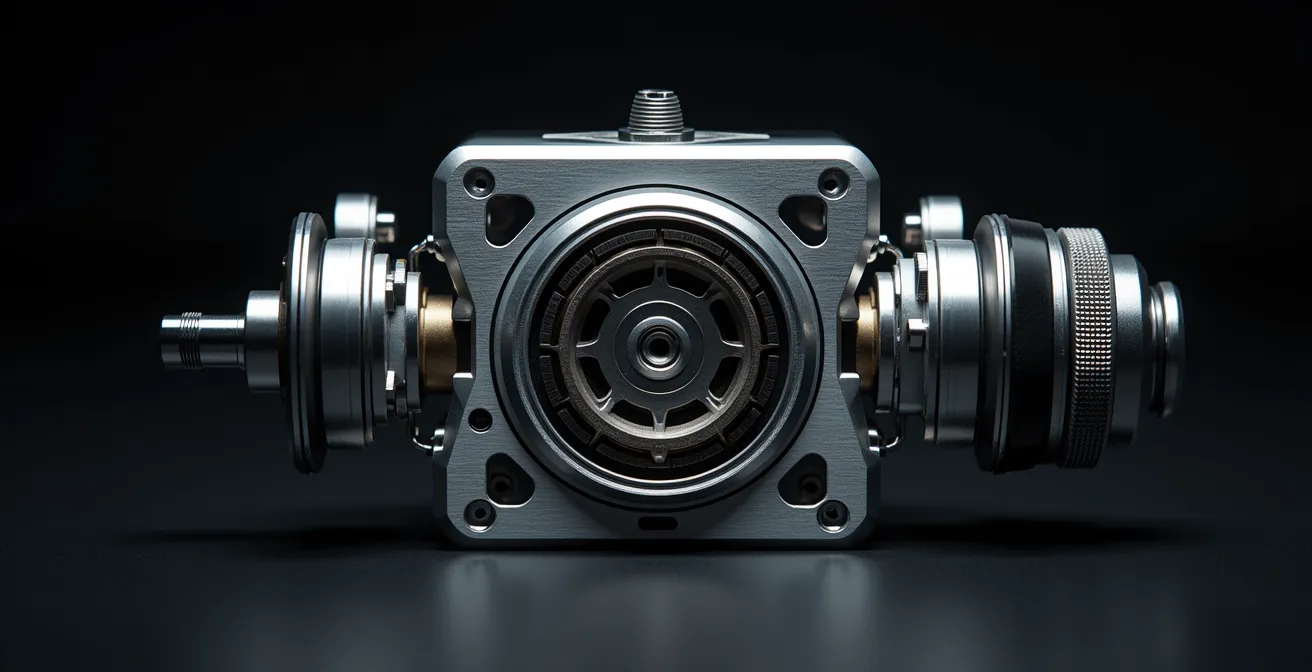
This near-instantaneous response is crucial for tricking the brain into accepting the virtual interaction as real. Further calibration involves user-specific tuning. Hand size, finger strength, and individual sensitivity thresholds are factored in to ensure the simulated forces are perceived correctly by each user. Through this sophisticated blend of physics simulation and electromechanical response, haptic devices translate abstract code into tangible, believable physical sensations.
Gloves vs Vests: Which Haptic Gear Provides Better Immersion?
The choice between haptic gloves and vests is not about which is “better” but which is appropriate for the specific training objective. Each device type targets different aspects of immersion and provides distinct forms of sensory feedback. The decision hinges on whether the skill being taught relies on fine motor manipulation or full-body spatial awareness and environmental interaction.
Haptic gloves, such as those from HaptX or SenseGlove, are designed for tasks requiring high dexterity and object interaction. They provide granular feedback to individual fingers, simulating an object’s shape, texture, and resistance. This is essential for training surgeons, assembly line workers, or technicians who need to develop a feel for tools and components. The immersion they provide is focused on the hands, creating a powerful connection to the virtual objects being manipulated. Haptic vests and suits, like those from Teslasuit or bHaptics, focus on full-body immersion. They use dozens of vibrotactile motors to simulate environmental effects like impacts, vibrations, or even the feeling of rain. This is ideal for training soldiers, firefighters, or first responders who need to develop situational awareness and react to stimuli affecting their entire body. They provide context and environmental feedback, rather than precise object interaction.
The increasing demand for more advanced haptic experiences is clear. In fact, market research reveals that 50% of VR headset owners are willing to pay a premium for better, more integrated haptic feedback. This drives innovation toward hybrid systems that combine the strengths of both gloves and vests for a complete sensory ecosystem.
The following table breaks down the optimal applications for each device type.
| Device Type | Best For | Feedback Points | Key Advantage |
|---|---|---|---|
| Haptic Gloves (HaptX, SenseGlove) | Fine motor skills, surgery, precision assembly | Individual finger feedback | Precise manipulation and grip strength simulation |
| Haptic Vests (Teslasuit, bHaptics) | Full-body training, impact simulation | 40+ vibration points across torso | Environmental feedback and spatial awareness |
The Risk of Relying on Haptics and Losing Real-World Sensitivity
While haptic feedback significantly enhances VR training, an over-reliance on simulated sensations presents a genuine risk: the potential for negative skill transfer or developing a dependency on the “perfect” feedback of the virtual world. A simulation, no matter how advanced, is an approximation. The real world is filled with imperfections—a slightly stripped screw, a component that doesn’t fit perfectly, a material with unexpected slickness. A trainee who has only ever experienced the idealized physics of a simulator may be unprepared for these real-world variables.
This can lead to a performance plateau. Research into surgical training has highlighted this phenomenon. A 2022 study published in *Surgical Endoscopy* found that while haptic training was beneficial, it also had a potential downside. The study observed that 46% of the haptic-trained group exhibited outcomes suggestive of a plateau phase, compared with only 6% of the non-haptic trained group. This suggests trainees may become adept at the simulation but struggle to adapt when faced with the unpredictability of live tissue.
The key to mitigating this risk is not to abandon haptics, but to integrate them into a blended learning model. VR training should be used to build a strong foundational skill set in a safe, repeatable environment. This must then be supplemented with real-world practice, where the trainee learns to adapt their haptically-trained muscle memory to the chaotic reality of physical objects. Intriguingly, some research suggests that this blended approach can lead to superior long-term retention. A French study on kinesthetic learning found that while physical training produced better immediate results, the VR-trained group showed better performance on a delayed post-test, indicating deeper encoding of the core skill.
The goal is to use haptics as a powerful accelerator, not a final destination. The simulation teaches the ideal, and real-world practice teaches adaptation.
How to Reduce Input Lag to Prevent Simulation Sickness?
Simulation sickness, a form of motion sickness with symptoms like nausea and disorientation, is one of the most significant barriers to the widespread adoption of VR training. It is primarily caused by sensory mismatch, especially a delay—or input lag—between a user’s physical movements and the corresponding update in the virtual environment. When a user turns their head or moves their hand and the visual display lags even by milliseconds, the brain’s vestibular system (which controls balance) and visual system receive conflicting information, leading to discomfort.
Reducing this latency is a multi-faceted engineering challenge. It requires optimizing the entire data pipeline, from the motion-tracking sensors to the rendering engine and the display itself. High-frequency tracking systems (120 Hz or higher) and powerful GPUs capable of maintaining high, stable frame rates are essential. Predictive tracking algorithms are also employed, which anticipate the user’s movements to begin rendering the next frame before the movement is even completed, effectively hiding a portion of the system’s inherent lag.
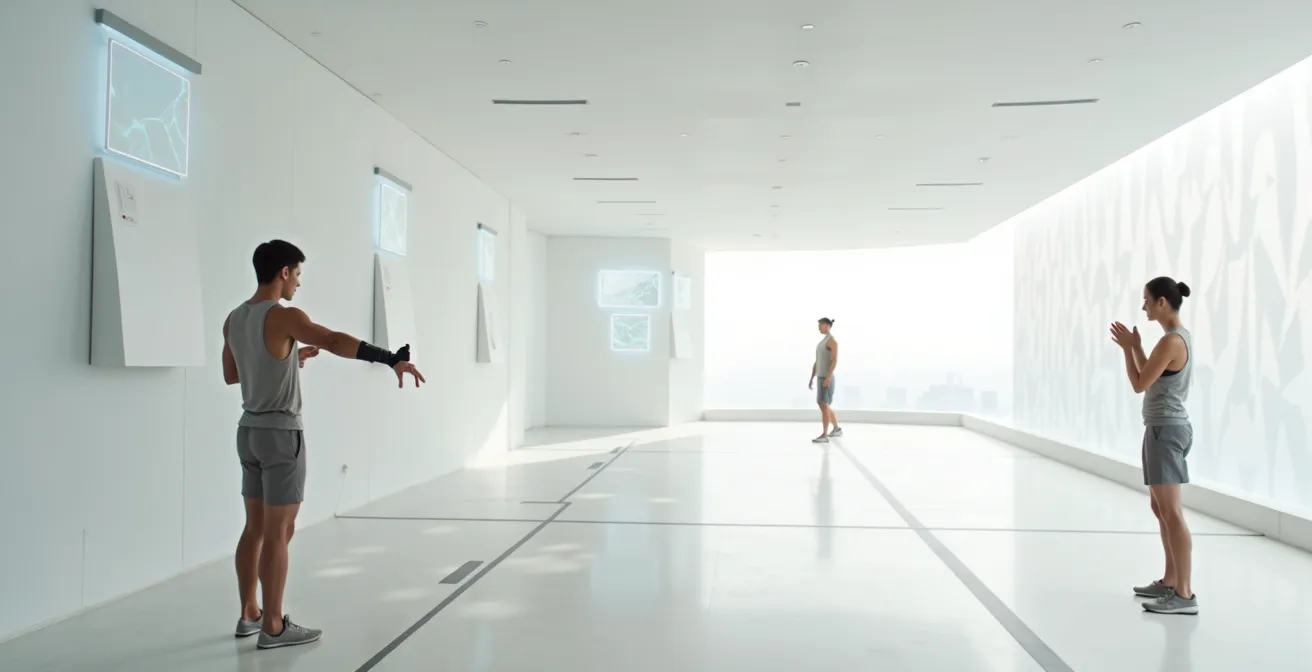
Interestingly, haptic feedback itself can play a role in mitigating simulation sickness. By providing an additional, congruent sensory input (touch), it helps ground the user in the virtual space and can make them less susceptible to purely visual-vestibular conflicts. The sensation of touching a virtual object that corresponds with a visual event reinforces the brain’s acceptance of the simulation. In fact, some research indicates a 20% reduction in simulator sickness symptoms when haptic feedback is incorporated. The tactile confirmation of an action seems to anchor the user’s perception, making minor visual lags less jarring.
Ultimately, preventing simulation sickness requires a holistic approach: high-performance hardware, optimized software, and thoughtfully designed experiences that avoid rapid, artificial movements. Haptics contribute by adding another layer of sensory confirmation, strengthening the illusion and making the experience more comfortable and sustainable for long training sessions.
Why Brains Retain Safety Protocols Better in VR Than in Classrooms?
Classroom-based safety training often fails because it is abstract and passive. Trainees read manuals or watch videos about potential hazards, but the information is processed on a purely intellectual level. There is no emotional or physical component to anchor the memory. VR training, especially when enhanced with haptics, transforms this passive learning into an active, experiential process that engages the brain on a much deeper level, leading to significantly better retention.
The core mechanism is experiential learning. When a trainee in a VR simulation makes a mistake—such as touching a high-voltage component or mishandling a hazardous chemical—the system can provide immediate, visceral feedback. Haptic feedback can simulate the jolt of an electric shock or the vibration of an unstable container. This creates a powerful and memorable “error correction signal.” The brain forms a strong associative memory linking the wrong action to a negative physical sensation. As explained by researchers at Strivr, this is a neurological process: “Haptics send specific signals through the brain, through the sense of touch, which enable the brain to form longer-lasting sense impressions.”
This process activates regions of the brain, like the amygdala (involved in emotional processing) and the motor cortex, that are largely dormant during passive classroom learning. The stress and consequence, even though simulated, make the memory more salient and durable. Instead of simply remembering a rule from a book, the trainee remembers the *feeling* of the mistake. This encoded physical memory is far more likely to be recalled and acted upon in a real-world, high-stress situation. This is why a firefighter who has felt the intense, vibrating feedback of a backdraft simulation is better prepared than one who has only read about it.
By allowing trainees to safely fail and physically experience the consequences, haptic VR forges memories that are not just known, but are deeply, physically understood.
Virtual vs Tactile Skills: What Do Students Lose by Not Touching Equipment?
The primary loss when transitioning from physical to purely virtual training is the infinite, unpredictable nuance of the real world. Real equipment has imperfections: wear and tear, subtle variations in material texture, the specific heft and balance of a tool. These are critical data points that an experienced professional internalizes over years of practice. Without haptics, this entire dimension of learning is lost. Students learn a sterilized, idealized version of a task, which can lead to a competency gap when faced with real-world messiness.
However, what is gained with high-fidelity haptics can, in some cases, outweigh what is lost. Haptic VR can provide “super-real” feedback, exaggerating certain sensations to accelerate learning. For instance, a trainee learning to detect subtle machine vibrations that signal impending failure can be exposed to an amplified version of that vibration in VR, making it easier to recognize. The technology also allows for the simulation of materials and scenarios that are impossible or too dangerous to provide physically. This is particularly valuable in fields like medicine or specialized manufacturing.
Case Study: Australian Meat Processing VR Training
In a prime example of simulating the impossible, a training course for the Australian meat processing industry was developed by Virtual There. Using the SenseGlove and VIVE hardware, trainees could learn the highly specialized skill of butchery in VR. The haptic system allowed them to feel the different textures of various meat cuts with a realism that would be impractical and wasteful to replicate in physical training at scale, demonstrating how haptics can teach skills that are otherwise difficult to access.
Therefore, the question is not simply one of loss. While the infinite variability of the real world is hard to replicate, haptic VR compensates by offering controlled, repeatable, and sometimes even enhanced sensory experiences. It allows trainees to focus on and internalize the most critical tactile cues of a task, building a strong foundation that can then be adapted to real-world conditions.
Key Takeaways
- Haptic feedback moves VR training from a visual-only exercise to a neuro-motor experience, directly engaging the brain’s motor cortex.
- High-fidelity force feedback, not just simple vibration, is the key to building transferable muscle memory for complex manual tasks.
- While haptics accelerate learning, they must be part of a blended model that includes real-world practice to prepare trainees for unpredictable variables.
How Immersive Job Training Reduces Workplace Accidents by 40%?
The significant reduction in workplace accidents attributed to immersive training is a direct result of building more reliable and quickly recalled muscle memory for safety-critical procedures. In high-stress situations, conscious thought is too slow; humans revert to ingrained training. Haptic VR excels at ingraining the correct physical responses by making them automatic. When a worker has physically practiced an emergency shutdown sequence a hundred times in a realistic simulation, feeling the resistance of the lever and the click of the switch, the action becomes second nature.
This is quantifiable. For example, research on emergency medical services training with AR/VR technologies showed a 46% improvement factor in first responder accuracy. Better accuracy in performing procedures under pressure directly translates to fewer errors and, consequently, fewer accidents. The training works because it allows for repetition to the point of automaticity in a context that mimics the stress of the real world without the real-world danger. A worker can experience a simulated catastrophic failure and practice the correct response until it is flawless, a learning opportunity that is simply not possible on a live factory floor.
Furthermore, the engagement level of haptic training leads to better knowledge retention. Data suggests that experiences feel more alive and engaging with haptic support, leading to longer and more focused training sessions. This increased “time on task” in a highly effective learning environment naturally leads to more robust skill formation. The reduction in accidents isn’t magic; it’s the logical outcome of better-prepared workers who can rely on deeply encoded physical training when it matters most.
Action Plan: Measuring the ROI of Haptic Safety Training
- Map Haptic Feedback to Risks: Assign specific haptic cues to accident categories (e.g., force-feedback for improper lifting techniques, vibrotactile alerts for proximity to a virtual hazard).
- Track Lead Metrics: Monitor performance in simulated emergencies, focusing on near-misses, procedural deviations, and response times, not just pass/fail outcomes.
- Conduct A/B Testing: Compare a haptic-trained cohort against a control group (traditional or non-haptic VR) on both simulated and real-world performance indicators over time.
- Teach Thresholds: Use haptics to let users feel when they are applying too much pressure, approaching a dangerous angle, or exceeding operational limits, thus internalizing a sense of boundaries.
- Correlate to Business Outcomes: Link improvements in lead metrics to a reduction in real-world incidents, equipment damage, and insurance premiums to calculate a clear return on investment.
The evidence is clear: by engaging the sense of touch, haptic VR training creates a more direct, efficient, and permanent pathway for encoding the physical skills that are crucial for workplace safety. To truly leverage this technology, the next logical step is to analyze your specific training needs and identify where the gap between seeing and feeling is causing the most significant risk.