Contrary to popular belief, breaking into the green economy isn’t about earning a new degree; it’s about strategically redeploying your existing technical skills.
- The highest demand is for technicians and engineers with hands-on expertise in electrical systems, mechanical diagnostics, and data analysis.
- Vocational certifications often provide a faster and more direct path to employment than traditional four-year degrees for specialized roles.
Recommendation: Instead of a broad search, identify the ‘skill adjacencies’ between your current role and a high-growth green sector like solar, wind, or energy storage.
The global shift to sustainable energy isn’t just a headline; it’s a seismic career event creating unprecedented demand for skilled technical professionals. For engineers and technicians looking on, the opportunity is clear, but the path is often obscured by a fog of generic advice. You’re told the sector is booming, that STEM skills are essential, and that you should consider going back to school for an environmental science degree. This is, at best, an incomplete picture. As a recruiter on the front lines of this transition, I can tell you that the most successful career pivots aren’t about starting over.
The real key to entering the green economy lies in a concept we’ll call skill adjacency—the strategic mapping of your current, hard-won technical expertise onto the most critical needs of the renewable energy sector. It’s about understanding that your experience with industrial machinery, electrical grids, or data systems is not obsolete; it’s the very foundation for a high-value role in solar, wind, or energy storage. The market doesn’t just need more people; it needs the right people with the right practical skills, and it needs them now.
This article moves beyond the buzzwords to provide a recruiter’s-eye view of the landscape. We will dissect which sectors hold the most promise, how to retrain effectively while you work, and why specialized technicians are currently some of the most sought-after (and well-compensated) professionals in the industry. Forget the idea of a four-year reset; this is your guide to a strategic redeployment of your technical career.
To navigate this transition effectively, this guide breaks down the essential information you need, from understanding market growth to choosing the right educational path.
Summary: Your Roadmap to a Career in the Green Economy
- Why Solar and Wind Jobs Are Growing 5x Faster Than Fossil Fuel Roles?
- How to Retrain for the Green Economy While Working Full-Time?
- Solar vs Hydrogen vs Wind: Which Sector Has the Best Long-Term Prospects?
- The Impact of Government Policy Changes on Green Job Stability
- How Mechanical Engineers Can Pivot to Wind Turbine Maintenance?
- Why Electricians Are Outearning Some College Graduates This Year?
- Why Updating STEM Standards is Crucial for National Economy?
- Vocational Certifications vs Degrees: Which Leads to Faster Employment?
Why Solar and Wind Jobs Are Growing 5x Faster Than Fossil Fuel Roles?
The narrative of renewable energy’s growth is often told in broad strokes, but the employment data reveals a more dramatic story of economic velocity. The primary drivers are twofold: rapidly falling technology costs and supportive government policies, which together have created an aggressive expansion cycle. Unlike mature fossil fuel industries where jobs are often tied to replacement or incremental gains, the solar and wind sectors are in a phase of exponential build-out. Every new solar farm and wind park represents a net-new cluster of jobs in manufacturing, installation, operations, and maintenance.
This isn’t slow, steady growth; it’s a land rush. The U.S. Department of Energy’s 2024 report quantifies this momentum, showing that in 2023 alone, there was a 5.3% growth in solar jobs and 4.5% in wind, far outpacing the overall economy. This expansion is happening across the country, with regions like the South experiencing particularly high job creation. This surge is creating a powerful vacuum for technical talent.
For engineers and technicians, this means that demand is not just high; it’s immediate. Companies are competing for a limited pool of qualified individuals who can design, install, and maintain these new assets. This creates a candidate-driven market where professionals with the right technical skills have significant leverage in negotiating salary, benefits, and career pathways. The growth isn’t just a statistic; it’s a direct signal of opportunity for those ready to make the pivot.
How to Retrain for the Green Economy While Working Full-Time?
The idea of “retraining” often conjures images of quitting your job to enroll in a multi-year degree program. This is a myth that holds back countless qualified professionals. The most effective strategy for engineers and technicians is not to start from zero, but to build a bridge from their existing expertise. This is the principle of skill adjacency in action. It involves identifying the core competencies of your current role—like understanding electrical systems, diagnosing mechanical failures, or managing complex projects—and mapping them to their equivalents in the renewable sector.
A full-time pivot is about targeted, strategic upskilling, not a complete overhaul. Start by focusing on micro-certifications, often offered directly by equipment manufacturers (like inverter or turbine companies), which can be completed in weeks. These credentials are highly valued by employers as they demonstrate proficiency on specific, in-demand equipment. Furthermore, consider “bridge” roles. If you’re a project manager in manufacturing, a role managing the construction of a solar farm is a natural next step. Documenting hands-on personal projects, such as building a home energy monitoring system, can also serve as powerful proof of your initiative and practical skills.
This approach is validated by labor market data. An industry report highlighted that a significant portion of the energy workforce is built on practical training, with 31% of energy sector workers having vocational training. This underscores that employers in this space prioritize demonstrable, applicable skills over purely academic credentials. Your path forward is not about erasing your past experience, but about adding a targeted layer of green-specific knowledge to make it immediately valuable.
Solar vs Hydrogen vs Wind: Which Sector Has the Best Long-Term Prospects?
For a technical professional planning a career pivot, choosing the right sector is as important as acquiring the right skills. While solar and wind are the established giants, emerging fields like energy storage and green hydrogen present different types of opportunities. The decision hinges on your career goals: are you seeking immediate employment in a mature, scaling market, or do you want to be on the ground floor of a future-defining technology?
Solar and wind are in a phase of scaling and optimization. The technology is proven, and the primary challenge is mass deployment and efficient operation. This creates a massive demand for installers, maintenance technicians, and operations engineers who can work with established systems. These sectors offer a high volume of jobs and relatively stable, predictable career paths. Energy storage, particularly battery technology, is in a state of rapid expansion, driven by the need to stabilize a grid with intermittent renewables. Roles here are growing explosively and often involve cutting-edge systems integration.
Green hydrogen, by contrast, is largely in the R&D and piloting phase. While it holds immense long-term potential for decarbonizing heavy industry and transport, the job market is currently smaller and concentrated in research, chemical engineering, and pilot project management. It’s a high-risk, high-reward frontier. The key is to match the sector’s maturity to your own risk tolerance and skill set.

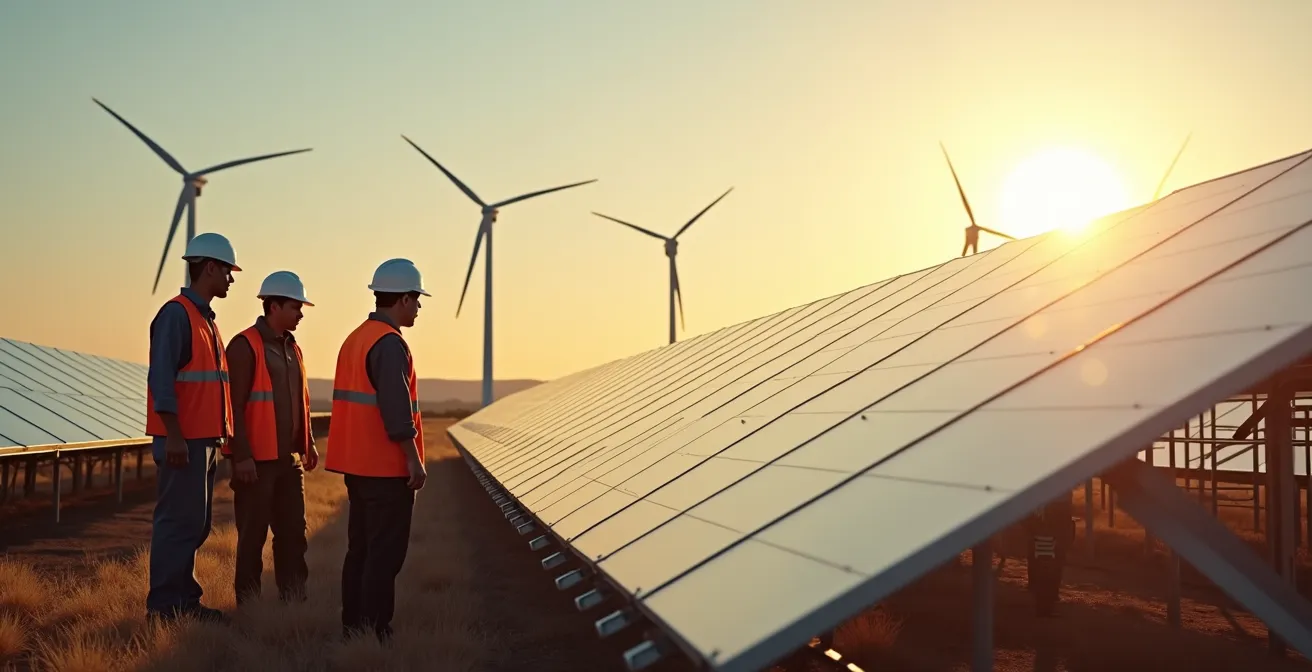
The visual contrast between these fields highlights the different work environments—from the sun-drenched expanse of a solar farm to the intricate mechanics inside a wind turbine or the high-tech precision of a battery facility. Each requires a distinct yet overlapping set of technical skills.
To make an informed decision, comparing these sectors on key metrics is essential, as detailed in the following analysis.
| Sector | Current Jobs (2024) | Growth Rate | Market Maturity |
|---|---|---|---|
| Solar Energy | 569,000 | 5.3% annually | Scaling & Optimization |
| Wind Energy | 125,000+ | 4.5% annually | Scaling & Optimization |
| Energy Storage | 93,497 | 17% (5-year) | Rapid Expansion |
| Hydrogen | Emerging | N/A | R&D & Piloting |
The Impact of Government Policy Changes on Green Job Stability
For any technician or engineer considering a move into a new industry, job stability is a primary concern. In the green economy, this stability is increasingly underwritten by long-term government policy and investment. Unlike the volatile boom-and-bust cycles of some industries, the transition to clean energy is now a matter of national infrastructure policy, creating a durable foundation for career growth. These are not short-term projects; they are decades-long transformations of the energy grid.
A prime example is the Infrastructure Investment and Jobs Act in the United States, which has allocated a massive $62 billion for Department of Energy clean energy projects. This funding directly translates into multi-year contracts for building and upgrading transmission lines, deploying new renewable generation, and developing energy storage facilities. For a technical professional, this means that the project you’re hired for today is likely part of a much larger, securely funded pipeline of work that will extend for years to come.
This policy-driven stability is also fostering higher-quality jobs. As the industry matures, it is also becoming more organized, with a clear trend towards unionization providing better wages, benefits, and safety standards. The U.S. Department of Energy highlights this significant shift:
For the first time ever unionization rates in clean energy, at 12.4%, surpassed the average rate in the energy sector of 11%, driven by rapid growth in unionized construction and utility industries. The sectors experiencing significant growth include zero-emission vehicle and renewable energy, as well as transmission, distribution, and storage.
– U.S. Department of Energy, 2024 U.S. Energy and Employment Report
This trend toward formalization and government backing signals that green energy careers are moving from a nascent, speculative field to a stable, foundational part of the national economy. This provides a crucial layer of security for anyone planning a long-term career in the sector.
How Mechanical Engineers Can Pivot to Wind Turbine Maintenance?
The pivot from traditional mechanical engineering to wind turbine maintenance is a prime example of skill adjacency. A wind turbine is, at its core, a massive piece of rotating machinery, and the fundamental principles of vibration analysis, tribology (the science of friction and lubrication), and materials science are directly transferable. If you have experience maintaining industrial gearboxes, pumps, or generators, you already possess 80% of the foundational knowledge required to be an excellent wind turbine technician.
The remaining 20% involves layering on specialized knowledge. This includes developing expertise in the composite materials used for turbine blades and the non-destructive testing (NDT) methods used to inspect them. It also means becoming proficient with the specific software that runs modern wind farms, such as SCADA (Supervisory Control and Data Acquisition) systems for remote monitoring and GIS (Geographic Information System) software for operational planning. Most critically, safety is paramount. Obtaining a Global Wind Organisation (GWO) Basic Safety Training certificate is non-negotiable for anyone who will be working at heights.
The incentive for making this pivot is enormous. The demand for qualified technicians is outstripping supply, leading to significant career opportunities. The U.S. Bureau of Labor Statistics has identified wind turbine technician as one of the fastest-growing occupations in the country, with a projected 60% growth from 2023 to 2033. For a mechanical engineer feeling stagnant or facing uncertainty in a traditional industry, the wind sector offers not just a job, but a high-growth, long-term career trajectory where their core skills are more valuable than ever.
Why Electricians Are Outearning Some College Graduates This Year?
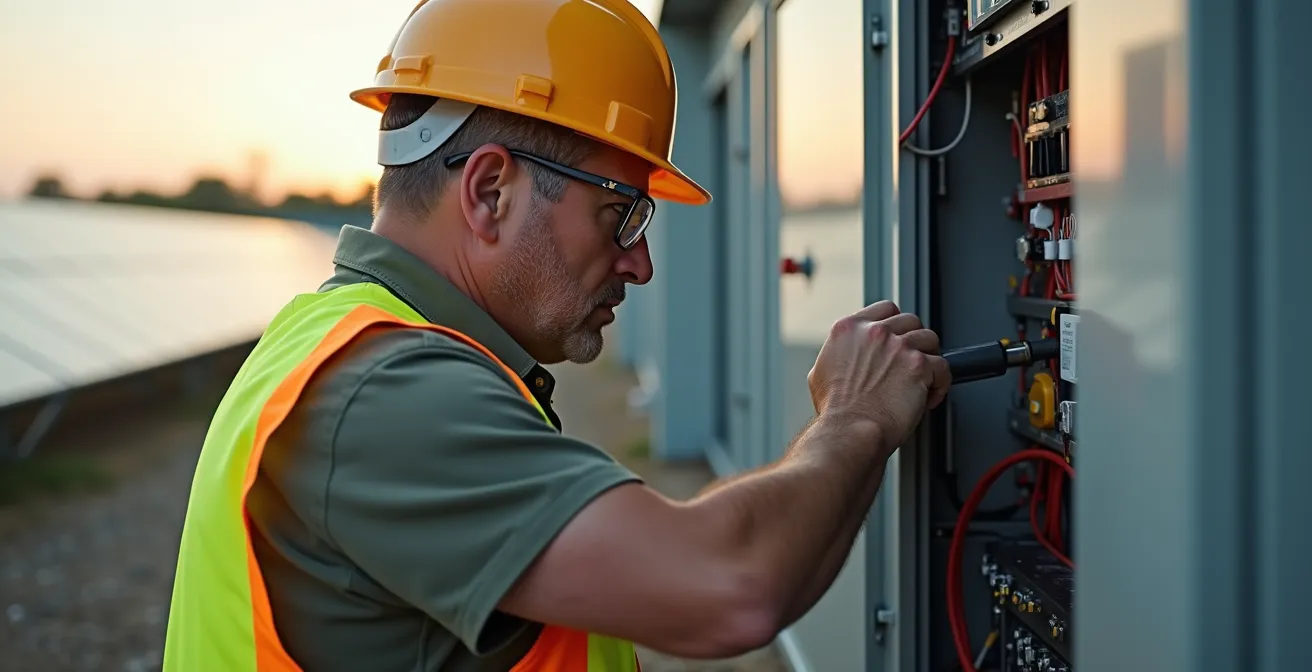
The energy transition is fundamentally an electrification of everything, and electricians are the indispensable soldiers on the front lines of this movement. This has created a massive surge in demand that the current labor supply cannot meet, leading to a phenomenon we call the “technician premium.” While headlines often focus on R&D engineers with advanced degrees, the most acute shortages—and therefore some of the most lucrative opportunities—are for skilled tradespeople who can actually build, connect, and maintain the new green infrastructure.
An electrician’s foundational knowledge of circuitry, load calculation, and safety protocols is the bedrock of every solar installation, EV charging network, and battery storage system. This has driven wages for specialized electrical workers to levels that surpass those of many entry-level white-collar jobs. For example, recent BLS data indicates a $92,560 median annual income for line workers, a figure that continues to climb in high-demand regions. This earning potential is amplified by specialization. Electricians who upskill in high-voltage DC systems, a key component of utility-scale solar and long-distance transmission, command an even higher premium.
This value is further enhanced by specific safety and standards certifications. Completing OSHA 30-hour training is a baseline for any supervisory role, while an NFPA 70E course on arc flash prevention is essential for anyone working on high-energy systems. These are not years-long commitments; they are targeted training modules that directly increase an electrician’s marketability and earning power. For those with a technical aptitude who are weighing the cost and time of a four-year degree against a hands-on career, the path of a specialized green-energy electrician offers a faster, more direct, and increasingly profitable route to success.
Why Updating STEM Standards is Crucial for National Economy?
The explosive growth of the clean energy sector is creating a disconnect between traditional STEM education and the real-world needs of the industry. While universities continue to produce excellent theoretical engineers, the front lines of the green economy are calling for professionals with a hybrid skill set grounded in systems thinking and practical application. The national economy’s ability to capitalize on the energy transition hinges on our educational system’s ability to adapt to this new reality.
As the International Energy Agency noted in a 2024 report, the global workforce is expanding rapidly to meet this challenge, but the skills required are evolving just as quickly.
As the clean energy sector experiences unprecedented growth, developing expertise in renewable technologies has become paramount for energy professionals. The industry witnessed remarkable expansion in 2023, with renewable energy workers reaching 36.2 million globally, marking a 4.3 million increase from 2021.
– International Energy Agency, 2024 Global Energy Employment Report
To meet this demand, STEM curriculums must shift from a purely theoretical focus to one that integrates hands-on experience. This means moving beyond calculus and physics to include lab work with grid-tie inverters, data science with Python scripting for energy analysis, and predictive maintenance principles using machine learning. More importantly, it requires creating parallel technician pathways that are valued as highly as traditional four-year engineering degrees. The future is not just about designing the next generation of solar cells in a lab; it’s about having an army of skilled technicians who can deploy, manage, and optimize entire energy ecosystems.
Action Plan: Key Updates for a Green-Focused STEM Curriculum
- Move from theoretical physics to hands-on labs with grid-tie inverters and battery systems.
- Integrate data science and Python scripting as foundational skills alongside calculus.
- Create parallel technician pathways alongside traditional 4-year engineering degrees.
- Emphasize systems thinking – how solar, battery, inverter, and grid interact.
- Include predictive maintenance and machine learning applications in the curriculum.
Key Takeaways
- The green economy’s primary need is for the strategic application of existing technical skills, not starting from scratch.
- Vocational training and targeted certifications are often a faster, more cost-effective path to high-demand roles than a new four-year degree.
- Job stability is being solidified by massive government infrastructure investment and growing unionization, making it a secure long-term career path.
Vocational Certifications vs Degrees: Which Leads to Faster Employment?
The most pressing question for many aspiring green-energy professionals is choosing the right educational path. The traditional default of a four-year engineering degree is being challenged by the speed and specific needs of the market. From a recruiter’s perspective, the answer is not one-size-fits-all; it depends entirely on your career ambitions and your desired time to employment. For roles that are hands-on and immediately deployable, vocational certifications often hold a distinct advantage.
A vocational certificate—for a solar PV installer, a wind turbine technician, or a battery storage specialist—is a targeted educational tool. It’s designed to get you job-ready for a specific role in a matter of weeks or months, not years. This pathway is significantly less expensive and provides a direct line to employment, meeting the industry’s urgent need for skilled labor on the ground. The growth in these roles is staggering; for example, Solar PV installer positions are projected to grow by 48% over the next decade, according to the U.S. Bureau of Labor Statistics.
A four-year degree, conversely, plays a longer game. It is best suited for those with ambitions in R&D, systems architecture, policy, or senior management. A degree provides a broader theoretical foundation, which allows for greater career flexibility across different sectors over the long term and typically leads to higher earning potential with experience. However, it comes at a much higher upfront cost in both time and money. The choice is a strategic one: a certification is a scalpel, designed for a precise, immediate impact. A degree is a broader instrument, designed for long-term versatility.
This comparative analysis, based on a framework from the Renewable Energy Institute’s look at future jobs, helps clarify the trade-offs.
| Aspect | Vocational Certification | 4-Year Degree |
|---|---|---|
| Time to Employment | Weeks to months | 4+ years |
| Cost | $3,000-$15,000 | $40,000-$200,000 |
| Best For | Specific hands-on roles (installer, technician) | Long-term ambitions (R&D, system architect) |
| Earning Potential | $50,000-$90,000 initially | $60,000-$120,000+ with experience |
| Career Flexibility | Role-specific, requires additional certs for pivoting | Broader opportunities across sectors |
Now that you understand the landscape, the next step is to perform a personal audit of your own skill adjacencies and identify the most direct path into the sector that best fits your expertise. Begin by mapping your current technical competencies to the job descriptions of high-growth roles and identify the one or two certifications that will bridge the gap.