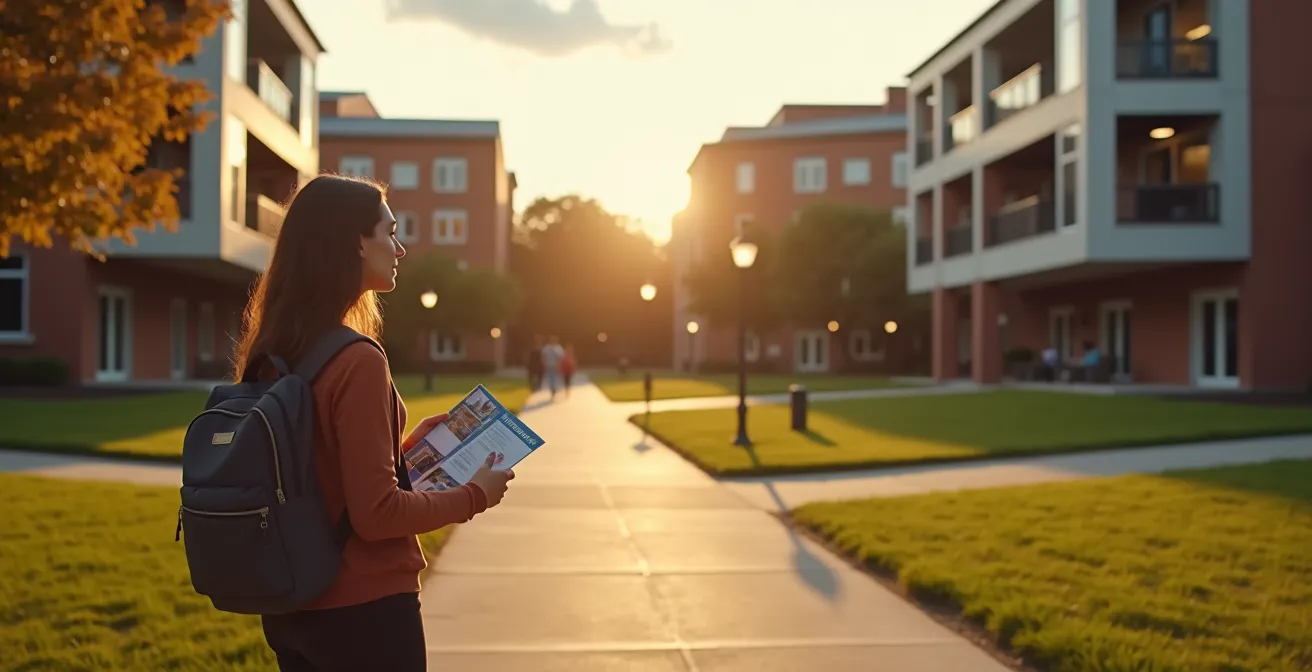
Choosing the right student housing is a strategic academic decision, not just a logistical one, directly impacting your GPA far more than you think.
- A long commute is a hidden GPA killer, creating a “friction cost” that depletes your energy and study time.
- Hidden fees and illegal lease clauses create “financial drag,” a form of stress proven to lower academic performance.
- Your living environment is an ecosystem; its social dynamics and proximity to resources create valuable “proximity capital.”
Recommendation: Audit your potential housing not for its amenities, but for its role in your personal “Academic Success Ecosystem” to ensure it supports, rather than sabotages, your goals.
The search for student housing often feels like a frantic scramble for four walls and a roof. You’re juggling budgets, locations, and potential roommates, with the primary goal of simply securing a place to live. The common advice revolves around the basics: find a quiet space, check for decent Wi-Fi, and try not to live too far from campus. While this advice isn’t wrong, it’s dangerously incomplete. It treats housing as a passive backdrop to your student life, a necessary expense to be minimized.
But what if this perspective is fundamentally flawed? What if your choice of housing is one of the most powerful, yet overlooked, tools for academic achievement? The truth is, where you live is more than just a place to sleep; it’s an active component of your success. It can either be a source of constant friction—draining your time, energy, and focus—or it can be a carefully designed ‘Academic Success Ecosystem’ that propels you forward.
This guide reframes the entire housing conversation. We will move beyond surface-level tips and delve into the hidden curriculum of housing. We’ll explore the science behind how commute times impact graduation rates, how to spot financial traps in your lease that create academic drag, and how to choose an environment that aligns with your personality and career goals. By the end, you won’t just be looking for an apartment; you’ll be engineering the optimal environment for your GPA, well-being, and future.
This article provides a comprehensive roadmap to making a strategic housing choice. We will cover the critical factors that influence academic performance, from the hidden costs of living off-campus to the career benefits of a well-chosen location.
Summary: A Strategic Guide to Student Housing and Academic Performance
- Why Living More Than 30 Minutes Away Lowers Graduation Rates?
- How to Spot Illegal Clauses in Student Housing Leases?
- Party Dorm vs Quiet Floor: Which Fits Your Personality?
- The Risk of Renting “Sight Unseen” Near Campus
- When to Start Looking for Fall Housing to Get the Best Deals?
- On-Campus vs Off-Campus: Which is Cheaper After Hidden Fees?
- Why Polytechnics produce Graduates Who Are “Job-Ready” Faster?
- How to Manage Dormitory and Living Costs Without Starving?
Why Living More Than 30 Minutes Away Lowers Graduation Rates?
The daily commute is often seen as a simple trade-off for cheaper rent, but its impact on academic success is profound and consistently underestimated. This isn’t just about lost time; it’s about the significant “friction cost” it imposes on your cognitive resources. Every minute spent in traffic or on a bus is a minute not spent in the library, at a professor’s office hours, or collaborating with a study group. This slow drain on your time and energy directly correlates with academic outcomes.
Research consistently shows that proximity matters. For instance, research from the University of Oregon demonstrates that first-time freshmen living on campus have higher GPAs, retention rates, and graduate faster. The logic is simple: living closer reduces barriers to engagement. You’re more likely to attend a last-minute study session, use the gym to de-stress, or participate in a campus event that builds your sense of belonging—all of which are linked to better academic performance.
A comprehensive study at the University of Connecticut powerfully illustrates this point. By analyzing data from 2010 to 2018, researchers found that students who lived on campus for their first two years had significantly higher GPAs and were more likely to stay enrolled. This “proximity capital”—the inherent value of being near campus resources—is a tangible asset. A long commute forces you to be more deliberate and scheduled, robbing you of the spontaneous academic and social interactions that are a cornerstone of the university experience and a key driver of success.
How to Spot Illegal Clauses in Student Housing Leases?
A housing lease is more than a formality; it’s a binding legal document that can either protect you or become a source of significant financial and mental stress. Landlords, particularly in competitive student markets, may include clauses that are questionable or outright illegal, creating a “financial drag” that can distract you from your studies. Understanding how to spot these red flags is a critical skill for protecting your finances and your focus.
One of the most common issues is the “joint and several liability” clause, which makes you financially responsible for your roommates’ unpaid rent. While legal in many places, it’s a massive risk you must understand before signing. Another red flag is an “as-is” clause that attempts to waive the landlord’s responsibility to provide a habitable living space (with essentials like running water and heat). These clauses are often unenforceable but can intimidate students into accepting poor conditions. Be vigilant about rules that seem overly restrictive, such as blanket bans on guests, which could violate your right to “quiet enjoyment” of your home.

Legislatures are starting to recognize these issues. For example, new legislation in California, effective in 2024, limits security deposits to just one month’s rent, preventing landlords from demanding excessive upfront payments. This shows a growing awareness of the need to protect tenants. Your best defense is a proactive one: read every single word of your lease before you sign it, and don’t be afraid to question anything that seems unfair or unclear.
Your Lease Red Flag Checklist: Points to Verify Before Signing
- Joint and Several Liability: Check for clauses that make you responsible for all roommates’ rent and damages. Understand the full financial risk.
- Habitability Waivers: Identify any “as-is” clauses. Landlords are generally required by law to provide a safe and habitable home, regardless of what the lease says.
- Unreasonable Penalties: Scrutinize fees for late rent or penalties for breaking the lease. Ensure they are reasonable and legal in your jurisdiction.
- Guest & Access Policies: Verify that guest restrictions are not overly prohibitive and that the lease specifies the notice required for landlord entry.
- Automatic Renewal: Look for automatic renewal clauses and note the exact deadline and method for giving notice that you will not be renewing.
Party Dorm vs Quiet Floor: Which Fits Your Personality?
The choice between a vibrant, social “party dorm” and a designated “quiet floor” seems straightforward, but the decision has nuanced effects on your academic success that go beyond noise levels. Your living environment is a powerful social ecosystem, and its structure can either foster or hinder the behaviors that lead to better grades. It’s not just about finding a quiet place to study; it’s about finding an environment that aligns with your personality and learning style.
Counterintuitively, a moderately social environment can be more beneficial than a completely isolated one. A study at a Southern liberal arts institution found that students in traditional corridor-style dorms—which naturally encourage interaction—had higher GPAs than those in more private, apartment-style housing. For first-year Black students, the effect was stark: a 2.3 GPA in corridor dorms versus 1.9 in apartments. This suggests that the spontaneous social support and academic collaboration that happen in common areas are a vital part of the “hidden curriculum” of on-campus living.
Of course, there’s a tipping point. An environment dominated by constant parties can be detrimental. The key is to find a balance. Living-Learning Communities (LLCs), which group students by academic interest, often strike this balance perfectly. They provide a strong social network grounded in shared academic goals. Data shows students in LLCs tend to have higher GPAs and study more hours per week than those in general or party-focused dorms. The decision isn’t about choosing between “fun” and “studying,” but about choosing an environment where the social culture inherently supports, rather than competes with, your academic ambitions.
The Risk of Renting “Sight Unseen” Near Campus
For students living far away or facing a competitive rental market, the temptation to sign a lease based only on online photos and a landlord’s description is strong. However, renting “sight unseen” is one of the biggest gambles you can take with your academic success ecosystem. The gap between a curated online listing and the reality of a living space can be vast, filled with issues that create daily friction and distract from your studies.
The pictures won’t tell you about the paper-thin walls that let you hear every word of your neighbor’s conversations. They won’t reveal the weak cell signal that turns every phone call into a frustrating ordeal, or the street noise from a nearby bar that makes studying impossible after 10 p.m. These aren’t minor inconveniences; they are chronic stressors that degrade your ability to rest, focus, and perform academically. A virtual tour might seem like a solution, but it’s still a curated experience. You can’t smell the mildew, feel the drafty window, or gauge the true noise level from a video call.

If you absolutely cannot visit in person, you must become a digital detective. Your goal is to verify the reality of the property through independent channels. Don’t just take the landlord’s word for it; your GPA may depend on it. Here are some essential steps:
- Request a live, unedited video tour: Ask the person to show you specific things, like turning on the shower to check water pressure, running a Wi-Fi speed test on camera, and holding the phone near a window to capture street noise.
- Use Google Maps Street View’s history feature: This allows you to see what the building and neighborhood looked like in previous years, revealing any recent decline or problematic changes.
- Check local crime maps and walkability scores: Assess the safety of your potential walking routes to and from campus, especially at night.
- Contact current tenants: Use social media or campus forums to find people who live in the building. A five-minute conversation can provide more truth than a hundred professional photos.
When to Start Looking for Fall Housing to Get the Best Deals?
The timing of your housing search is a strategic game with a direct impact on your wallet and your well-being. Starting too early or too late involves significant trade-offs in price, quality, and negotiation power. Understanding this timeline allows you to move from a reactive search to a proactive strategy, securing a better place for a better price, which in turn reduces financial stress throughout the academic year.
Most students assume “the earlier, the better,” but this isn’t always true. An analysis of search patterns reveals a clear dynamic: students searching in February and March find the widest selection of high-quality options, but they often pay a premium of 10-15%. Landlords know they have the leverage. Conversely, students who wait until late July or August face a severely limited selection but can often negotiate deep discounts of 20-30% from landlords desperate to fill vacancies. This is a high-risk, high-reward strategy that can leave you with a suboptimal living situation.
The strategic “sweet spot” for most students falls between late April and early May. By this time, the initial frenzy has died down, but there is still a good inventory of quality housing available. Landlords are more willing to negotiate, and you have enough time to conduct proper due diligence without the pressure of a looming move-in date. This period offers the best balance of choice, price, and peace of mind. Waiting until the summer might seem like a good way to save money, but the stress of a last-minute search and the risk of ending up in a place with high friction costs can easily negate any financial savings.
This table breaks down the trade-offs of timing your housing search.
| Search Period | Options Available | Price Level | Negotiation Power |
|---|---|---|---|
| February-March | Excellent (90%+) | Premium (+15%) | Low |
| April-May | Good (70%) | Standard | Moderate |
| June-July | Fair (40%) | Discounted (-10%) | High |
| August | Limited (20%) | Deep Discount (-25%) | Very High |
On-Campus vs Off-Campus: Which is Cheaper After Hidden Fees?
The on-campus versus off-campus debate is typically framed around a simple calculation: the monthly rent of an apartment versus the semester cost of a dorm. This comparison is dangerously misleading because it ignores the significant hidden costs—in both time and money—associated with living off-campus. When you build a complete “True Cost” calculation, the cheaper option is often not what it seems.
The most significant hidden cost is time. As established, commute time directly eats into study time. A comprehensive study from Mbarara University found that off-campus students spend 4.36 fewer hours studying per week. That’s over 65 fewer hours of study time per semester. What is your GPA worth per hour? This “time tax” is a massive, un-budgeted expense. Furthermore, off-campus living involves time spent on meal prep, grocery shopping, and commuting that on-campus students can dedicate to academics or extracurriculars.
Beyond time, there are numerous hidden financial costs. Off-campus rent rarely includes utilities, high-speed internet, or furniture. You are also responsible for your own groceries, transportation costs (gas, parking permits, transit passes), and potentially even minor maintenance. These expenses add up quickly. A dorm fee, while appearing large upfront, is often an all-inclusive price that covers these variables, providing budget predictability and reducing financial stress. To make a true comparison, you must look beyond the rent and calculate the total cost of living.
- Financials: Add up rent, utilities (electricity, water, gas), internet, parking fees, and renter’s insurance.
- Food: Estimate your monthly grocery bill plus the cost of any meals you’ll eat out.
- Transportation: Calculate monthly gas, insurance, maintenance, or public transit costs.
- Time Value: Assign a monetary value (e.g., minimum wage) to your weekly hours spent commuting, cooking, and cleaning. This represents time you *could* have been studying or working.
Why Polytechnics produce Graduates Who Are “Job-Ready” Faster?
At first glance, a discussion about polytechnic institutes might seem out of place in a guide to student housing. However, the core principle of a polytechnic education—a strategic, hands-on approach designed for career readiness—provides the perfect metaphor for how you should approach your housing choice. Just as these institutions are engineered to produce job-ready graduates, your housing can and should be chosen to make *you* job-ready faster.
Your address is more than a place to live; it’s a launchpad for your career. The “proximity capital” gained from living near campus resources also applies to professional opportunities. Choosing housing strategically located near business districts, tech hubs, or hospitals relevant to your field can dramatically increase your access to internships, networking events, and part-time jobs that build your resume. This isn’t theoretical; a study on the topic found that students who made this strategic choice reported 45% higher internship participation rates.
Furthermore, the type of neighborhood matters. Living in an area populated only by undergraduates can limit your professional exposure. In contrast, choosing housing in a mixed neighborhood with graduate students and young professionals can help you build valuable “weak tie” social networks. These are the acquaintances and friends-of-friends who often provide the introductions and insider information that lead to job offers. The same study found that students in these mixed areas received 30% more job offers upon graduation. Your housing choice, therefore, becomes a direct investment in your post-graduation career prospects.
- Map Your Opportunities: Before signing a lease, map all potential internship and job locations within a 30-minute commute radius.
- Research Neighborhood Demographics: Look for areas with a healthy mix of students and young professionals in your target industry.
- Evaluate Access: Consider proximity to public transit that serves key business districts, not just the university.
- Identify Networking Hotspots: Are there coffee shops, co-working spaces, or industry-specific venues nearby where you can organically connect with professionals?
Key takeaways
- Your housing choice is an active part of your academic strategy, not a passive backdrop.
- Hidden costs like commute time (“friction cost”) and financial stress (“financial drag”) have a direct, negative impact on your GPA.
- Proximity to both academic resources and professional opportunities (“proximity capital”) is a tangible asset that accelerates success.
How to Manage Dormitory and Living Costs Without Starving?
For many students, the pressure to cover rent and living expenses is a constant source of stress. This isn’t just a personal challenge; it’s an academic one. The “financial drag” created by money worries is a powerful negative force on your ability to learn and perform. In fact, research published in Trends in Psychology confirms that students experiencing high levels of financial stress have, on average, a GPA that is 0.38 points lower. Managing your costs effectively is therefore a direct strategy for protecting your grades.
The most common solution—getting a part-time job—requires a strategic approach. Not all jobs are created equal in the context of an academic success ecosystem. A job with inflexible hours that is far from campus might pay slightly more per hour, but the friction costs of commuting and the inability to study during downtime can lead to a net negative impact on your GPA. The goal is to find work that complements, rather than competes with, your studies.
On-campus jobs are often the ideal solution. Working at the library, as a research assistant for a professor, or in an administrative office often provides flexible hours that accommodate your class schedule and, crucially, downtime that can be used for studying. These roles also build your “proximity capital,” strengthening your connections to the university community and faculty. The pay may be slightly lower than an off-campus retail job, but the positive or neutral impact on your GPA makes it a far better investment in your long-term success. When choosing how to fund your living costs, always evaluate the job’s impact on your primary objective: earning your degree.
This table illustrates the trade-offs between different types of student jobs.
| Job Type | GPA Impact | Benefits | Drawbacks |
|---|---|---|---|
| On-campus library | +0.15 | Study during downtime, faculty connections | Limited hours |
| Research assistant | +0.22 | Academic skill building, networking | Competitive |
| Off-campus retail | -0.18 | Higher pay potential | Inflexible hours, commute |
| Food delivery | -0.25 | Flexible schedule | Unpredictable income, car costs |
Stop seeing housing as a line item on a budget and start treating it as a strategic investment in your success. Use these frameworks to audit your next potential home not just as a place to live, but as the cornerstone of your academic achievement. By consciously designing your academic success ecosystem, you take control of the hidden variables that determine your ability to thrive.