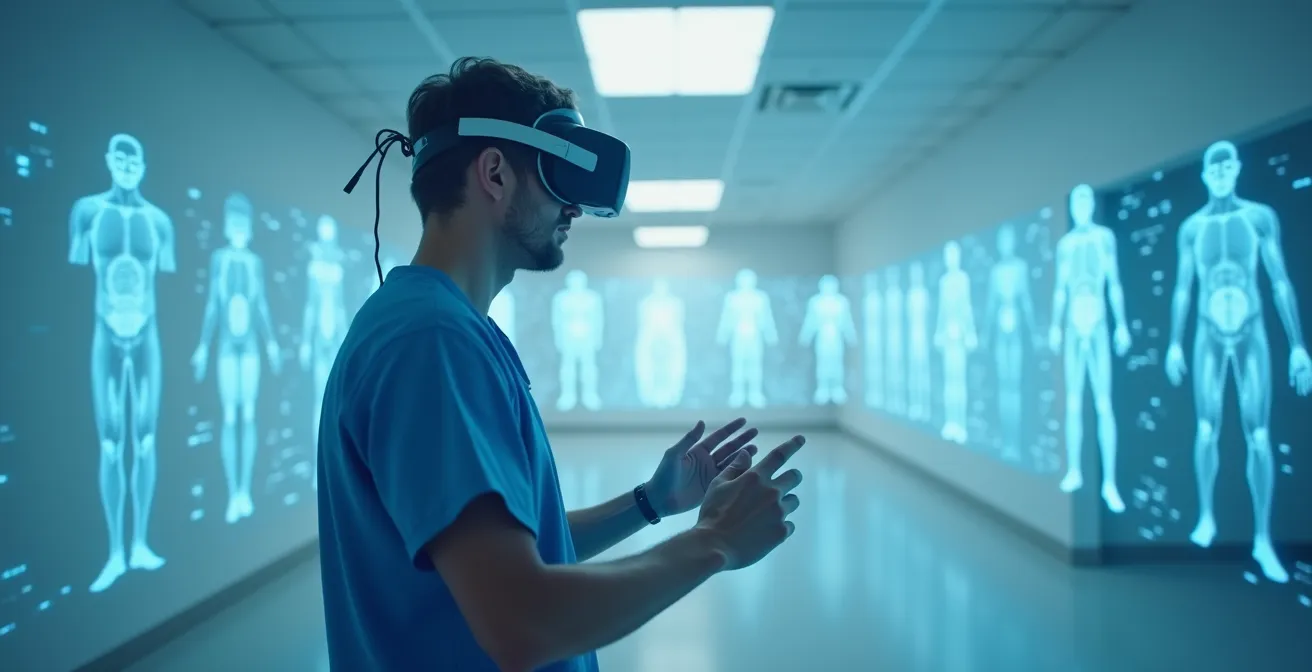
Repetition alone does not create experts for high-stakes events; it is the quality and context of that repetition that defines mastery.
- Virtual Reality allows for “cognitive rehearsal” under simulated stress, ingraining procedural memory far more effectively than passive learning or simple repetition.
- Haptic feedback and deliberate practice loops within VR accelerate skill acquisition, measurably reduce critical errors, and build verifiable confidence.
Recommendation: Shift focus from if VR should be used to how it must be integrated to systematically inoculate professionals against stress and failure in rare procedures.
The core challenge in training for high-consequence professions, such as surgery or aviation, is not the routine but the rare. A surgeon may perform a standard appendectomy hundreds of times, but only face a catastrophic intraoperative hemorrhage a few times in their entire career. The traditional “see one, do one, teach one” model is fundamentally inadequate for preparing professionals for these low-frequency, high-stakes events. It relies on chance exposure and offers no safe environment to practice failure management. While theoretical knowledge is essential, it often collapses under the immense cognitive load of a real-world crisis.
Conventional wisdom suggests more practice is the answer. However, simply increasing hours with traditional methods doesn’t address the core issue: the lack of high-fidelity, consequence-free environments to build not just skill, but resilience. This is where a fundamental paradigm shift is required. What if the key was not merely more practice, but a different kind of practice? This is the central premise of VR simulation: to act as a cognitive rehearsal engine. It is a technology designed not just to teach movements, but to recalibrate the brain’s response to stress, ingrain procedural muscle memory, and allow for infinite, deliberate practice on the very edge of failure.
This article will deconstruct how VR simulation achieves this superior level of preparation. We will explore the mechanisms behind accelerated confidence, the design of effective stress-inducing scenarios, the critical role of haptic feedback, and the economic justification for this technology. The focus will be on the “why” and “how”—providing a strategic framework for training directors to implement VR not as a novelty, but as a core component of elite professional development.
Summary: A Strategic Overview of VR Simulation for High-Stakes Skill Acquisition
- Why Infinite Repetition in VR Builds Confidence Faster Than Real Practice?
- How to Design Realistic VR Scenarios That Mimic Stressful Conditions?
- AR vs VR: Which is Better for Industrial Maintenance Training?
- The High Upfront Cost of VR Hardware: Is It Worth It for Small Teams?
- When to Introduce Simulation: Before or After Theory Classes?
- Why Brains Retain Safety Protocols Better in VR Than in Classrooms?
- Why You Retain 75% More Knowledge Through Hands-On Workshops?
- How Haptic Feedback Accelerates Muscle Memory in Virtual Training?
Why Infinite Repetition in VR Builds Confidence Faster Than Real Practice?
Confidence in a high-stakes environment is not a feeling; it is the product of proven competence. Traditional surgical training offers limited opportunities for repetition, especially for rare procedures. Virtual Reality fundamentally shatters this limitation. The key is not just infinite repetition, but deliberate practice. VR allows a trainee to isolate and repeat the most challenging 10-second segment of a multi-hour procedure hundreds of times, a concept known as micro-looping. This is impossible in a real-world setting. This focused repetition targets specific weaknesses, rapidly converting clumsy execution into fluid, automatic movements.
This method of training builds procedural memory at an accelerated rate, moving skills from the conscious, slow-processing part of the brain to the reflexive, fast-acting cerebellum. The result is a quantifiable leap in performance. For example, a study from UCLA’s David Geffen School of Medicine found that surgeons who trained using a VR platform demonstrated a 230% improvement in their overall surgical performance compared to their traditionally trained counterparts. This is not a marginal gain; it is a transformational one.

The illustration above visualizes this concept: the ghosted overlays represent the micro-loops of practice, where subtle adjustments in grip and movement are refined until they become second nature. This process builds a deep-seated confidence that is resilient to stress because it is founded on countless, successfully executed micro-tasks. The surgeon enters the operating room not just hoping they can perform, but knowing they can, because they have already done so, flawlessly, a thousand times.
How to Design Realistic VR Scenarios That Mimic Stressful Conditions?
A VR simulation’s value is directly proportional to its realism, not just visually, but psychologically. For high-stakes training, the goal is not to create a comfortable learning space but to engineer a stress inoculation environment. This requires designing scenarios that deliberately introduce the very complications and stressors that cause failure in the real world. This goes beyond simple procedural steps to include dynamic, unpredictable events that force critical thinking under pressure.
Effective scenario design involves several layers. First, the baseline procedure must be accurate. Then, stressors are introduced. These can include auditory distractions (e.g., rising heart rate monitors, irrelevant alarms), visual obstructions (e.g., simulated bleeding that obscures the surgical field), or unexpected equipment failures. The simulation should also feature time pressure, forcing the trainee to make decisions efficiently. The most advanced scenarios incorporate branching narratives, where a small error can cascade into a major crisis, requiring the user to manage the consequences of their actions in real-time.
The purpose of these high-fidelity failure scenarios is to expose trainees to cognitive overload in a controlled setting. By repeatedly navigating these stressful situations, they learn to manage their physiological stress response, maintain situational awareness, and execute protocols correctly despite the pressure. The effectiveness of this approach is clear; research demonstrates a 67% reduction in the need for instructor prompts for trainees who have undergone VR stress training. They are not just learning a procedure; they are learning to perform it under duress.
AR vs VR: Which is Better for Industrial Maintenance Training?
While this article focuses on surgical training, the principles are directly applicable to other high-consequence fields like industrial maintenance, where a single error can have catastrophic consequences. A frequent point of confusion is the distinction between Augmented Reality (AR) and Virtual Reality (VR). Choosing the right technology depends entirely on the training objective. AR and VR are not interchangeable; they serve fundamentally different purposes.
Augmented Reality (AR) overlays digital information onto the real world. In a maintenance context, an engineer wearing AR glasses could see a machine’s schematics, live sensor data, or step-by-step instructions projected directly onto the physical equipment they are servicing. Its primary strength is in-situ guidance and enhancing accuracy during the execution of standard, real-world tasks.
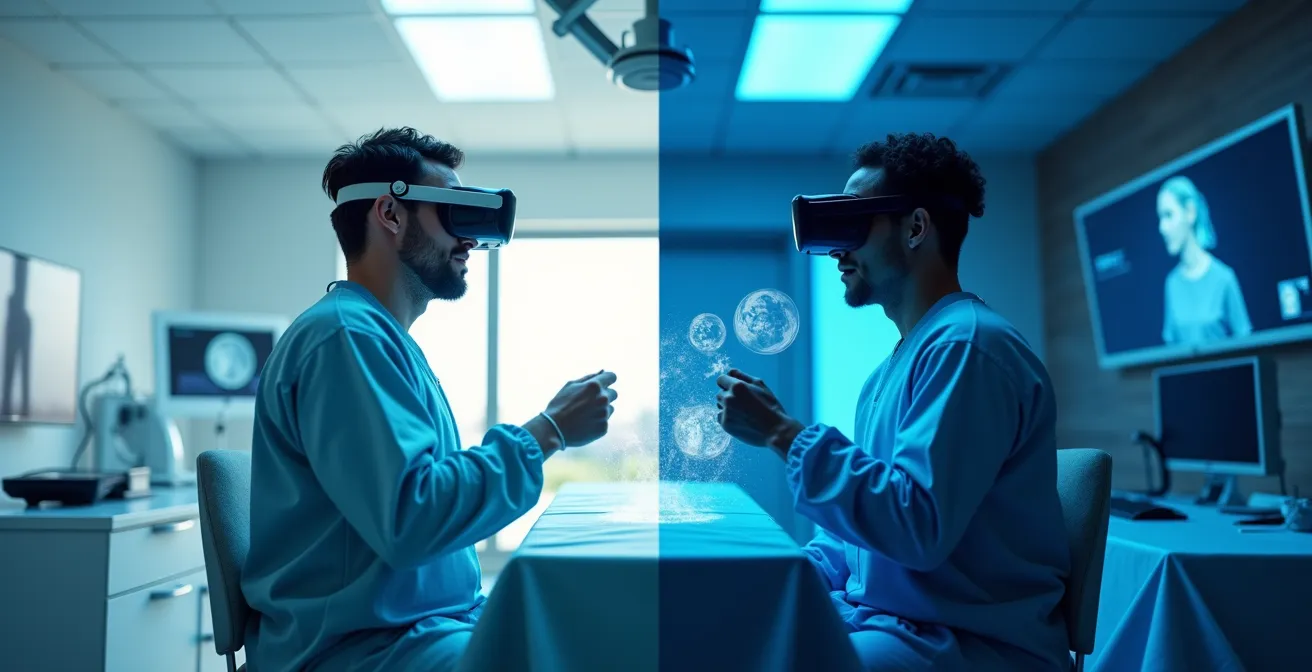
Virtual Reality (VR), in contrast, creates a fully immersive, completely digital environment. It removes the user from the real world to place them in a simulated one. Its strength lies in preoperative or pre-maintenance rehearsal, especially for procedures that are too rare, dangerous, or expensive to practice in reality. It is the ideal tool for crisis rehearsal and building foundational skills from scratch in a zero-risk setting. The following table breaks down the core differences in a surgical context, which directly mirror industrial applications.
| Feature | Augmented Reality (AR) | Virtual Reality (VR) |
|---|---|---|
| Primary Use Case | Intraoperative guidance with real-time overlay | Preoperative crisis rehearsal and skill building |
| Training Focus | Real-time 3D model overlay on actual patients | Complete immersion for rare procedure practice |
| Hardware Cost | $3,500-$15,000 per device | $500 or less for Meta Quest devices |
| Best Application | Standard procedure accuracy enhancement | High-risk, low-frequency procedure mastery |
The High Upfront Cost of VR Hardware: Is It Worth It for Small Teams?
The single greatest barrier to the adoption of high-fidelity VR simulation is the perceived cost. The financial investment can seem daunting, particularly for smaller institutions or teams. While consumer-grade VR headsets are affordable, professional-grade systems with specialized software and haptic feedback devices represent a significant capital expenditure. According to industry analysis, the upfront cost of VR technology ranges from $25,000 to $250,000 for a complete, high-fidelity setup.
However, framing this as a simple cost is a strategic error. It must be evaluated as an investment and weighed against the staggering cost of failure. A single adverse surgical event or industrial accident can result in costs far exceeding the price of a training system, factoring in liability, extended care, reputational damage, and operational downtime. The question is not “Can we afford VR training?” but “Can we afford not to have it?”. The return on investment comes from mitigated risk, improved efficiency, and reduced skill decay for infrequently performed, critical procedures.
To justify the investment, a rigorous cost-benefit analysis is required. This is not a vague exercise but a structured process of quantifying both direct and indirect costs associated with the current training paradigm and comparing them to the potential savings and performance gains from a VR program. For teams with limited capital, exploring VR-as-a-Service (VaaS) subscription models can provide access to state-of-the-art software without the large upfront hardware purchase, making this transformative technology accessible.
Action Plan: Cost-Benefit Analysis Framework for VR Training Investment
- Calculate the cost of a single adverse surgical event including malpractice liability and extended patient care.
- Assess the frequency of rare procedure training needs in your institution.
- Compare VR-as-a-Service subscription models versus hardware purchase options.
- Factor in skill decay mitigation benefits for infrequently performed procedures.
- Evaluate team scalability – VR software can be deployed on unlimited devices after initial development.
When to Introduce Simulation: Before or After Theory Classes?
The integration of simulation into a training curriculum is as important as the technology itself. A common debate centers on timing: should trainees engage with simulation before, during, or after they have absorbed the theoretical knowledge from textbooks and lectures? Traditional linear models (“learn first, then do”) are being challenged by more integrated approaches, such as the spiral curriculum, where theory and practice are interwoven.
Evidence increasingly suggests that introducing simulation early, even before all theory is mastered, can be highly effective. Engaging in a hands-on, albeit virtual, experience provides context that makes subsequent theoretical learning more meaningful. When a trainee has already grappled with a procedural challenge in VR, the textbook explanation of that challenge becomes a solution to a felt problem, rather than an abstract concept. This “doing before knowing” approach can significantly boost engagement and knowledge retention. The VR healthcare market is experiencing rapid expansion with a projected 35% compound annual growth rate (CAGR), indicating a broad-based shift towards these integrated models.
This approach transforms passive learners into active problem-solvers. They come to the classroom with questions born from experience, leading to deeper and more durable understanding. The ideal model is not a simple “before or after” but a continuous loop where simulation provides experiential context for theory, and theory then informs more advanced and nuanced performance in the next simulation session.
Spiral Curriculum Implementation in VR Surgical Training
A study involving plastic surgery residents investigated the use of a simulation-based cleft surgery website. Residents were assessed based on ten required steps verified by expert craniofacial surgeons. The digital simulation group, who engaged with the hands-on tool, significantly improved their surgical knowledge, procedural confidence, and surgical performance. In contrast, the control group using only textbooks showed no significant improvement. Crucially, the digital simulator was overwhelmingly favored by residents over textbooks for its educational quality, demonstrating the power of early, integrated hands-on learning.
Why Brains Retain Safety Protocols Better in VR Than in Classrooms?
Classroom learning and manual reading are fundamentally passive activities. They engage the brain’s declarative memory system, which is responsible for recalling facts and concepts. While necessary, this system is notoriously fragile under stress. Safety protocols memorized from a PowerPoint slide can evaporate in the heat of a crisis. VR training, however, engages a different, more robust neural pathway: procedural memory, the same system that allows you to ride a bicycle without conscious thought.
When a trainee executes a safety protocol in a realistic VR simulation—for instance, managing a sudden equipment malfunction—they are not just reading about it; they are physically doing it. This process creates a powerful association between the critical situation and the correct physical response. The brain encodes the entire experience—the visual cues of the problem, the auditory alarms, the cognitive pressure, and the motor sequence of the solution—into a single, durable memory trace. This is learning by doing, amplified by sensory immersion.
This experiential encoding is why retention is dramatically higher. The knowledge is not just “known,” it is “embodied.” The results are stark: research shows non-VR trained residents were 5 times more likely to make critical errors during a procedure than their VR-trained counterparts. They are not just faster or more confident; they are fundamentally safer. They have built an ingrained, almost reflexive, competence in emergency response that a classroom lecture can never hope to replicate.
Why You Retain 75% More Knowledge Through Hands-On Workshops?
The principle that we learn best by doing is not new. The “learning pyramid” concept, while debated in its specifics, captures a fundamental truth: active participation leads to higher retention than passive consumption. Hands-on workshops have long been a staple of effective training for this reason. Virtual Reality can be understood as the ultimate evolution of the hands-on workshop: a scalable, repeatable, and perfectly safe environment for applied learning.
Unlike a physical workshop that requires significant logistical setup, resources, and instructor time for a small group, a VR simulation can be deployed to hundreds of trainees simultaneously. It provides every user with an identical, high-quality, hands-on experience. This is not just a theoretical benefit; it is a proven methodology for accelerating expertise. A meta-analysis of 339 participants showed that VR significantly improved objective performance scores, demonstrating the power of this virtual “hands-on” approach. The data shows its measurable impact across the board.
The widespread adoption of this technology by leading institutions serves as a powerful proof of concept. It is no longer a niche or experimental tool but a validated platform for professional development at the highest levels.
Osso VR Platform Implementation Across Medical Institutions
Osso VR, co-founded in 2016 by a UCLA- and Harvard-trained pediatric orthopedic surgeon, exemplifies this trend. The platform was born from a direct need to improve training for complex procedures. Today, it is a trusted tool in hospitals and medical device companies worldwide, used by more than 100,000 healthcare professionals. This scale of adoption underscores the transition of VR from a promising idea to an essential, mainstream component of modern medical education, validating the “hands-on” digital workshop model.
Key Takeaways
- VR is not practice; it’s a cognitive rehearsal engine for stress and failure management.
- Effective scenarios must induce psychological stress to build resilience (stress inoculation).
- The primary value of VR is in mastering rare, high-risk procedures, justifying its cost against the cost of failure.
How Haptic Feedback Accelerates Muscle Memory in Virtual Training?
Visual and auditory immersion in VR are powerful, but for procedural skills, they are only part of the equation. Muscle memory—the cornerstone of surgical and technical proficiency—is built not just on what you see, but what you feel. Haptic feedback, the technology that simulates the sense of touch, is the critical component that closes the sensory loop and accelerates the development of this embodied knowledge.
When a surgeon in a non-haptic VR simulation manipulates a virtual instrument, their hands move through empty air. The brain receives visual confirmation of the action but no corresponding tactile sensation. With haptics, when the virtual drill touches virtual bone, the controller provides precise resistance. When cutting through different tissue layers, the feedback changes subtly. This congruence between visual action and physical sensation is vital. It provides the brain with the rich, multi-sensory data it needs to build a robust and accurate motor program.
This added layer of realism directly translates to faster skill acquisition and more refined movements. The trainee learns the “feel” of the procedure—how much force to apply, the texture of different materials, the subtle cues of a successful maneuver. This is not a minor enhancement; it is a fundamental accelerator of learning. Data confirms this, showing that VR training significantly reduced task completion times, a direct indicator of improved efficiency and ingrained muscle memory. Haptics bridges the final gap between simulation and reality, making the virtual practice profoundly more transferable to real-world performance.
To effectively prepare your teams for low-frequency, high-consequence events, the next logical step is to develop a structured VR curriculum. Begin by auditing your organization’s most critical procedural gaps and mapping them to specific, objective-driven simulation scenarios that incorporate both stress inoculation and deliberate practice.