Technology & e-learning
The intersection of technology and education has evolved from simple digitized textbooks to sophisticated ecosystems that fundamentally reshape how knowledge is acquired, retained, and applied. Today’s learning landscape encompasses immersive simulations, intelligent algorithms that adapt to individual needs, and platforms that dissolve geographical barriers to educational access. Whether you’re an educator seeking to enhance engagement, a corporate trainer managing compliance requirements, or a job seeker navigating algorithm-driven application systems, understanding these technological tools has become essential rather than optional.
This comprehensive exploration examines the core technologies driving modern e-learning, from virtual reality environments that make dangerous training scenarios safe, to artificial intelligence systems that personalize education at unprecedented scale. We’ll uncover how these innovations address longstanding educational challenges while introducing new considerations around privacy, accessibility, and implementation. By understanding both the mechanics and the practical implications of these tools, you’ll gain the context needed to make informed decisions about which technologies align with your specific learning or training objectives.
Virtual Reality and Immersive Learning Environments
Virtual reality has transitioned from gaming novelty to powerful educational tool, particularly in contexts where real-world practice carries significant risks or costs. The technology creates consequence-free learning spaces where mistakes become valuable teaching moments rather than safety hazards or expensive errors.
Safety Training Through Simulation
Consider industrial safety training, where a single mistake could result in injury or equipment damage. VR simulations allow learners to experience hazardous scenarios—chemical spills, machinery malfunctions, emergency evacuations—with complete psychological engagement but zero physical risk. The repetition value proves particularly significant: trainees can practice the same emergency response dozens of times, building muscle memory and decision-making confidence that translates directly to real situations. Research consistently shows that this experiential repetition produces retention rates far exceeding traditional video-based or lecture-format safety training.
Implementation Considerations and Costs
Organizations exploring VR training face a strategic decision matrix balancing several factors:
- Hardware selection: standalone headsets versus tethered systems, each with distinct quality-cost tradeoffs
- Content development: custom scenario building versus purchasing pre-built training modules
- Deployment timing: pre-boarding integration for new hires versus ongoing refresher training
- Technical infrastructure: latency reduction requirements and device calibration processes
The initial investment typically appears substantial, but organizations report compelling returns when measured against reduced incident rates, decreased equipment damage during training, and accelerated competency development. A manufacturing facility implementing VR forklift training, for example, might spend several thousand on equipment and software, but eliminate the costs associated with dedicating actual machinery and warehouse space to novice operator practice.
Addressing Desensitization and Psychological Risks
An often-overlooked consideration involves the psychological impact of highly realistic simulations. Safety psychology research indicates that excessive exposure to simulated emergencies without corresponding real-world stakes can potentially create emotional desensitization. Training programs must therefore balance realism with appropriate debriefing, contextual framing, and varied scenario presentation to maintain the psychological seriousness that ensures skills transfer effectively to actual emergency situations.
Remote Access to Laboratories and Specialized Equipment
Geographic and economic barriers have traditionally limited access to sophisticated scientific and technical equipment. Remote laboratory technologies fundamentally challenge this limitation, enabling students at under-resourced institutions to conduct experiments on equipment located hundreds or thousands of miles away.
Expanding Educational Accessibility
A biology student at a small rural college can now operate an electron microscope housed at a major research university, viewing specimens in real-time and adjusting parameters through a web interface. This democratization of access extends beyond higher education into K-12 curriculum integration, where students can engage with authentic scientific instruments rather than simplified educational approximations. The accessibility benefits prove particularly transformative for students with disabilities, as remote interfaces can be customized with assistive technologies more easily than physical laboratory spaces.
Hybrid Optimization and Curriculum Integration
The most effective implementations combine remote access with strategic in-person experiences. A chemistry curriculum might use remote spectroscopy for routine analytical work while reserving hands-on laboratory time for synthesis techniques requiring physical manipulation. This hybrid optimization maximizes both equipment utilization and pedagogical effectiveness, ensuring students develop theoretical understanding alongside practical skills. The technical risks—network connectivity issues, equipment malfunctions, scheduling bottlenecks—require robust backup plans and clear communication protocols to prevent student frustration from undermining the learning experience.
Artificial Intelligence and Personalized Learning Pathways
Artificial intelligence represents perhaps the most transformative technology in education’s current evolution, offering the possibility of truly individualized instruction at scale. Think of AI learning systems as infinitely patient tutors that observe every interaction, identify knowledge gaps with precision, and adjust instructional approaches in real-time.
Algorithm Mechanics and Adaptive Structures
Modern adaptive learning platforms continuously analyze multiple data inputs: response accuracy, hesitation duration, question sequencing, and even patterns in incorrect answers. These systems construct detailed models of each learner’s current understanding, then algorithmically select subsequent content to optimize the learning trajectory. A student struggling with algebraic fractions might receive additional foundational practice on fraction concepts before advancing, while a peer who demonstrates mastery moves immediately to application problems. This dynamic pathway adjustment happens automatically, delivering personalization that would be impossible for a single instructor managing dozens of students simultaneously.
Speed Optimization Versus Depth of Learning
The efficiency gains prove remarkable—students frequently reach competency benchmarks in significantly less time than traditional fixed-pace instruction. However, educators must carefully monitor whether speed optimization inadvertently sacrifices depth of understanding. An algorithm optimized purely for assessment performance might advance students who’ve memorized procedures without grasping underlying concepts. Effective implementation therefore requires:
- Clear definition of learning objectives that include conceptual understanding, not just procedural proficiency
- Algorithm design that values explanation quality and transfer ability alongside correct answers
- Regular human oversight to identify students advancing rapidly but superficially
- Structure comparison across different student cohorts to validate that efficiency gains represent genuine learning rather than assessment gaming
Confronting Algorithmic Bias
AI learning systems inherit biases present in their training data and design assumptions. An algorithm trained predominantly on data from one demographic group may inadvertently disadvantage learners with different cultural references, linguistic backgrounds, or prior knowledge structures. The bias risk extends beyond demographic factors to learning style assumptions—systems that heavily favor rapid response times may undervalue the deliberative thinking approaches of reflective learners. Responsible implementation demands ongoing bias auditing, diverse representation in system design teams, and mechanisms for students to flag content that feels culturally inappropriate or pedagogically confusing.
Mobile Learning and Micro-Learning Architectures
The ubiquity of smartphones has created opportunities for learning experiences that fit into fragmented time—commutes, waiting rooms, breaks between obligations. Micro-learning reimagines content delivery for these contexts, structuring knowledge into discrete, focused units consumable in minutes rather than hours.
Designing for Attention Span and Device Constraints
Effective mobile learning acknowledges both cognitive and technical realities. Human attention span in mobile contexts tends toward shorter durations, not due to inherent inability to focus, but because mobile device usage typically occurs in environments rich with potential interruptions. Content design must therefore prioritize completion-appropriate scope—a single concept explained thoroughly rather than superficial coverage of multiple topics. Device constraints similarly shape design decisions: screen size limits information density, touch interfaces require larger interaction targets than mouse-based systems, and variable network connectivity necessitates offline capability for essential content.
Distraction Management and Synchronization
The same device delivering educational content also provides instant access to social media, messaging, entertainment, and countless other distractions. Successful mobile learning platforms implement gentle focus mechanisms—progress indicators that create completion motivation, strategic notification timing that encourages return without pestering, and sync optimization that ensures seamless transitions between devices. A learner might begin a module on their phone during a commute, then continue on a tablet at home, with the system automatically maintaining progress and adapting the interface to each device’s capabilities.
Corporate Training Platforms and Learning Management Systems
Organizations face complex requirements around employee training: regulatory compliance documentation, skill development tracking, onboarding standardization, and knowledge dissemination at scale. Modern learning management systems (LMS) attempt to centralize these diverse needs into unified platforms.
Vendor Selection and Feature Comparison
The corporate LMS marketplace offers dozens of options, each emphasizing different capabilities. Organizations must evaluate candidates against their specific priorities:
- Compliance tracking sophistication: audit trail completeness, certification renewal automation, regulatory reporting capabilities
- Integration flexibility: compatibility with existing HR systems, single sign-on implementations, data export options
- Content versatility: support for diverse formats from traditional documents to interactive simulations
- User experience quality: interface intuitiveness that minimizes friction and support ticket generation
The selection process frequently reveals tensions between IT preferences (security, integration, administrative control) and end-user needs (accessibility, intuitiveness, engagement). Platforms that excel technically but create user friction suffer from low completion rates and negative employee perception, undermining their theoretical capabilities.
Gamification Optimization and Engagement Strategies
To combat the widespread perception of mandatory training as tedious obligation, many platforms incorporate gamification elements—points, badges, leaderboards, progress visualization. When thoughtfully implemented, these mechanisms genuinely enhance motivation and completion rates. However, poorly designed gamification can backfire, creating competition that discourages struggling learners or trivializing serious content. The most effective approaches use data-driven insights to continuously refine engagement strategies, identifying which mechanics resonate with different employee segments and adjusting accordingly.
Technology-Enhanced Job Search and Application Processes
The employment landscape increasingly involves algorithmic gatekeepers that filter applications before human review. Understanding these systems has become crucial for job seekers navigating modern hiring processes.
Application Algorithms and Visibility Mechanics
Applicant tracking systems (ATS) parse resumes for keywords, formatting patterns, and content structures that match position requirements. These algorithms determine which applications reach hiring managers and which disappear into digital oblivion. The visibility mechanics reward strategic keyword optimization—naturally incorporating terminology from job descriptions without artificial stuffing that triggers spam detection. Successful candidates understand that their resume must satisfy both algorithmic parsing and eventual human reading, requiring a delicate balance between machine readability and human appeal.
Timing Strategies and Ghosting Risks
Submission timing influences algorithmic prioritization in ways that aren’t immediately obvious. Applications submitted shortly after posting may receive preferential positioning, while those arriving after significant volume accumulates risk algorithmic deprioritization. Simultaneously, the digitization of hiring processes has unfortunately enabled “ghosting”—organizations that never respond to applications, leaving candidates in indefinite uncertainty. Job seekers increasingly employ platform comparison strategies, noting which employers and application systems provide status transparency versus those where applications enter a communication void.
The technologies reshaping education and employment share a common characteristic: they amplify both possibilities and responsibilities. Virtual reality makes dangerous training safe but requires psychological awareness. AI personalizes learning at scale but demands vigilance against algorithmic bias. Remote laboratories democratize access but need robust technical infrastructure. Mobile learning fits fragmented time but must compete with endless digital distractions. Understanding these tools means recognizing not just their capabilities but their limitations, implementation challenges, and the critical human decisions that determine whether technology serves learning objectives or becomes an obstacle to them. As these systems continue evolving, the fundamental principle remains constant—technology should enhance human learning and development, never replace the judgment, creativity, and contextual wisdom that effective education requires.

Cut Your Study Time in Half: The Efficiency Engine of Adaptive Learning Platforms
The core value of adaptive learning isn’t just personalization; it’s the systematic elimination of cognitive waste, enabling professionals to achieve mastery in up to half the time. AI algorithms perform a rapid, precise knowledge diagnosis to pinpoint exactly what you…
Read more
How Haptic Feedback Accelerates Muscle Memory in Virtual Training?
Haptic feedback accelerates virtual training not by simply adding ‘realism,’ but by providing direct proprioceptive data that allows the brain to encode physical movements more efficiently than through visual cues alone. Visual-only VR training forces the brain to translate abstract…
Read more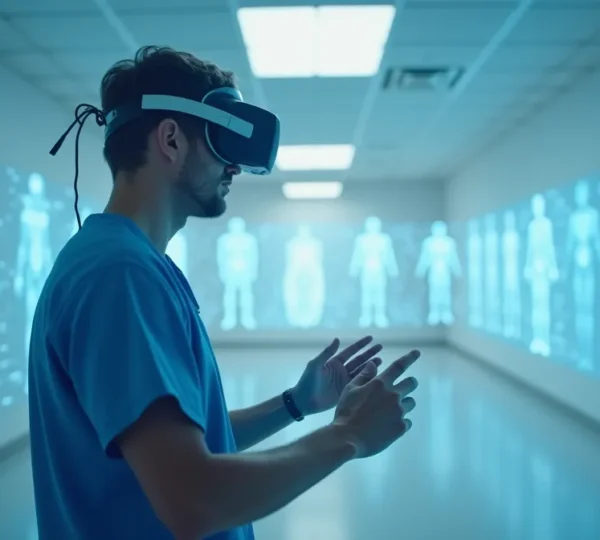
How VR Simulations Prepare Surgeons for Rare High-Risk Procedures?
Repetition alone does not create experts for high-stakes events; it is the quality and context of that repetition that defines mastery. Virtual Reality allows for “cognitive rehearsal” under simulated stress, ingraining procedural memory far more effectively than passive learning or…
Read more
How Learning Management Systems Reduce Corporate Training Costs by 30%?
A strategic Learning Management System (LMS) reduces training costs not just by cutting travel and venue expenses, but by transforming training from a cost center into a measurable driver of operational efficiency. An LMS directly mitigates financial risk by automating…
Read more
How to Turn Your “Dead Time” Into Highly Productive Mobile Study Sessions
In summary: Transform wasted moments into powerful learning opportunities by building a deliberate mobile study system. Focus on short, high-intensity “active recall bursts” instead of passively consuming content to maximize retention. Create a distraction-proof “digital sanctum” on your phone to…
Read more
How EdTech Solutions Are Improving Student Engagement in Remote Classrooms?
Boosting remote student engagement isn’t about accumulating more digital tools; it’s about building an integrated ‘engagement ecosystem’ where technology serves pedagogy. Effective EdTech relies on using data analytics to proactively identify learning gaps, not just on deploying interactive apps. Success…
Read more
The Disciplined Path: A CISO’s Roadmap from Novice to InfoSec Analyst
Becoming a top-tier InfoSec analyst is not about collecting certifications; it’s about building a portfolio of strategic, transferable assets. The massive job gap exists not from a lack of people, but a mismatch in strategic skills like cloud security and…
Read more
Virtual Labs vs. Physical Labs: Why ‘Replacement’ Is the Wrong Question for Higher Ed
The debate isn’t about replacing hands-on labs; it’s about specializing the learning experience for superior outcomes. Virtual labs excel at developing cognitive skills (procedural logic, data analysis) in a consequence-free environment. Physical labs remain essential for mastering tactile motor skills…
Read more
How Immersive Job Training Reduces Workplace Accidents by 40%?
VR training slashes accident rates not by being a better screen, but by fundamentally re-engineering an employee’s cognitive and neurological responses to risk. It creates “muscle memory” for safety protocols in a psychologically safe environment, where failure is a learning…
Read more
An ATS Developer Reveals: How to Optimize Your Profile to Beat the Recruitment Algorithms
Beating recruitment algorithms isn’t about keyword-stuffing; it’s about making your resume perfectly parsable for the machine and compelling for the human. ATS software rejects a vast number of qualified candidates due to simple formatting and keyword-matching failures. A tiered keyword…
Read more